CME Crypto Futures Data Is Live: Real-Time BTC & ETH Tick Streams (BTC, MBT, ETH, MET)
tickstream now streams CME Bitcoin and Ether futures in real time — BTC, Micro Bitcoin (MBT), ETH and Micro Ether (MET) as raw trade prints with size and aggressor side, over the same WebSocket and REST API as NQ and ES. What CME crypto futures data gives you that spot-exchange feeds can't, contract basics, code examples, and honest notes on what we don't have yet.
As of this week, tickstream streams CME crypto futures in real time: Bitcoin (BTC), Micro Bitcoin (MBT), Ether (ETH) and Micro Ether (MET) — raw trade prints with size and aggressor side, over the exact same WebSocket and REST API that already carries NQ, ES, gold, crude and FX.
No new integration, no separate key, no crypto-specific schema. If your code can subscribe to NQ, it can subscribe to BTC by changing one string.
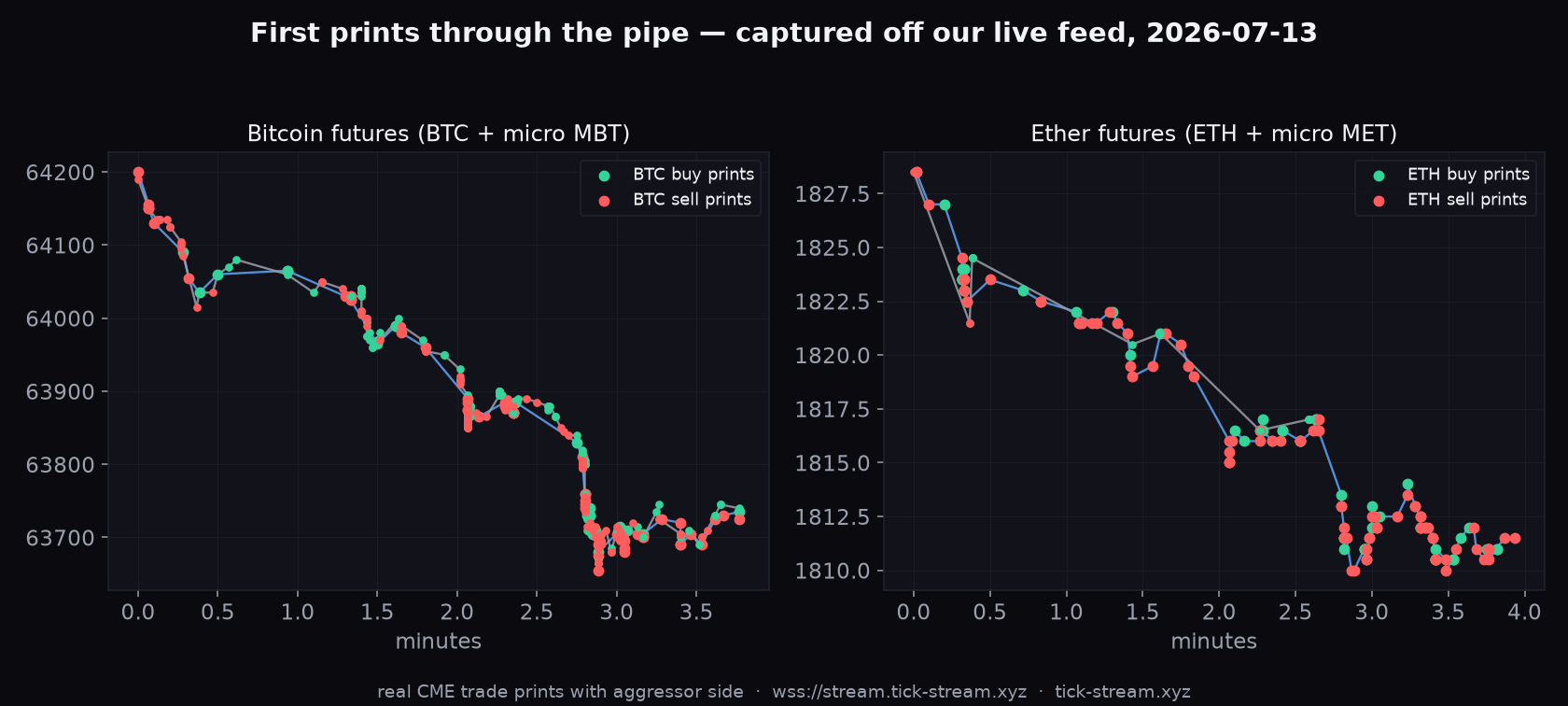
Those are real prints off our own pipe on launch day — every dot a trade at CME, green where the buyer crossed the spread, red where the seller did.
Why futures, not another spot API
There are a hundred APIs that will sell you Binance candles. That’s not what this is, and the difference matters for anyone doing quantitative work:
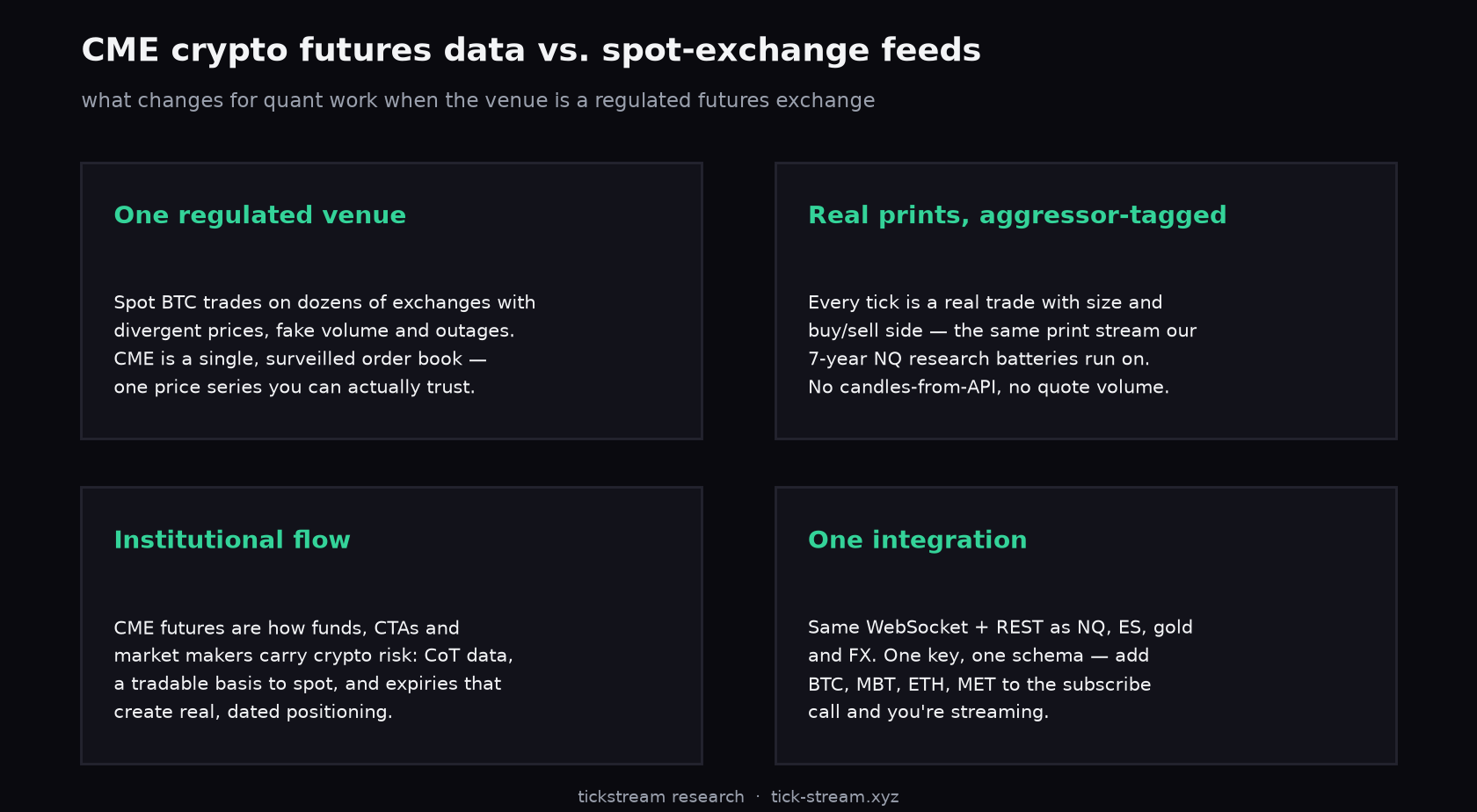
One regulated venue. Spot Bitcoin trades on dozens of exchanges at slightly different prices, with wash trading and fake volume as a documented, persistent feature of the landscape. CME is a single surveilled order book. When you backtest against it, you’re testing against one price series that institutions actually transact on — not a volume-weighted average of venues you can’t audit.
Real prints, aggressor-tagged. Every message is an actual trade: price, size, and which side initiated. This is the same data structure our entire research catalog runs on — the 7-year NQ tick archive behind every backtest and debunk we’ve published. Most crypto APIs give you aggregated OHLCV; the tape is a different animal.
Institutional structure. CME futures are how funds and CTAs carry crypto risk. That brings things spot doesn’t have: a tradable basis between futures and spot, dated monthly expiries (last Friday of the month) that create real positioning events, and CFTC Commitment of Traders reporting on top.
Micro contracts for realistic sizing. MBT is 0.1 BTC and MET is 0.1 ETH — the crypto equivalents of MNQ. If you’re building or testing a strategy at retail size, the micros are the honest instrument to model.
The contracts in one table
| Symbol | Product | Contract size | Listing | Expiry |
|---|---|---|---|---|
| BTC | Bitcoin futures | 5 BTC | monthly | last Friday |
| MBT | Micro Bitcoin | 0.1 BTC | monthly | last Friday |
| ETH | Ether futures | 50 ETH | monthly | last Friday |
| MET | Micro Ether | 0.1 ETH | monthly | last Friday |
Trading hours are the Globex session you already know from index futures: Sunday 6:00 PM ET through Friday 5:00 PM ET, ~23 hours a day. Our feed serves the continuous front month and rolls automatically a few days before expiry, so BTC always points at the contract that’s actually trading.
Getting the stream
One WebSocket, JSON out:
npx wscat -c "wss://stream.tick-stream.xyz?key=YOUR_KEY&symbols=BTC,MBT,ETH,MET"
{"type":"tick","symbol":"BTC","price":64375.0,"size":1,"side":"sell","exch":"CME","ts":1783901802}
{"type":"tick","symbol":"MBT","price":64435.0,"size":1,"side":"buy","exch":"CME","ts":1783901802}
REST snapshot, if you just need the current price:
curl "https://api.tick-stream.xyz/v1/quote?symbol=BTC" -H "Authorization: Bearer YOUR_KEY"
Crypto is included in the existing real-time plans — it’s a symbol, not an upsell.
What we don’t have (yet)
House policy is to say this part out loud. Deep tick history for crypto doesn’t exist here yet. Our NQ archive goes back seven years because we’ve been recording it for that long; crypto recording started at launch, July 2026, and the archive deepens from here — the same way the NQ one was built. If a vendor offers you “10 years of CME crypto tick data with aggressor side,” ask them exactly where it came from, because CME’s own crypto volume barely existed at today’s granularity that far back.
And no, we haven’t validated any crypto trading edge. When the recorded history is deep enough to run our standard batteries — honest fills, session robustness, placebo controls, the whole checklist — BTC gets the same treatment NQ gets, and we’ll publish whatever falls out, either way.
The short version
- BTC, MBT, ETH, MET — live now, real CME prints with aggressor side
- Same WebSocket + REST + key as the rest of the catalog
- Continuous front month, auto-rolled (monthly, last-Friday expiry)
- History recording started July 2026 and grows daily
- Spot-exchange feeds tell you what retail did on one venue; the futures tape tells you what size did on the venue that settles
Questions, or want a symbol we don’t carry yet? support@tick-stream.xyz.
Frequently asked questions
What CME crypto futures does tickstream stream in real time?
All four CME crypto products: BTC (Bitcoin futures, 5 BTC per contract), MBT (Micro Bitcoin, 0.1 BTC), ETH (Ether futures, 50 ETH) and MET (Micro Ether, 0.1 ETH). Each streams as raw trade prints with price, size and buy/sell aggressor side, plus best bid/ask — the same normalized schema as our NQ, ES, metals and FX feeds.
Why use CME futures data instead of a spot exchange API like Binance or Coinbase?
Spot crypto is fragmented across dozens of venues with divergent prices and unreliable volume. CME is a single regulated order book where funds, CTAs and market makers actually carry crypto risk. You get one trustworthy price series, real prints with aggressor side rather than aggregated candles, and futures-specific structure — a tradable basis to spot, monthly expiries, and CFTC Commitment of Traders positioning.
How do I subscribe to the BTC futures stream?
One WebSocket connection: wss://stream.tick-stream.xyz?key=YOUR_KEY&symbols=BTC,MBT — every message is a JSON tick with symbol, price, size, side and timestamp. REST snapshots are available at /v1/quote?symbol=BTC. Crypto is included in existing real-time plans; it's the same API key and the same schema as the equity-index feed.
When do CME Bitcoin futures trade and expire?
Nearly 23 hours a day, Sunday 6:00 PM ET through Friday 5:00 PM ET, with a one-hour maintenance break — the same Globex session as equity index futures. Contracts list monthly and expire on the last Friday of the contract month; our feed rolls the continuous front month automatically a few days before expiry.
Is historical CME crypto tick data available too?
Forward from July 2026. We started recording crypto prints when the feed went live, the same way we built our 7-year NQ tick archive — so the history deepens every day. For deep multi-year backtests today, crypto futures history isn't there yet, and we'd rather say that plainly than sell you a gap.