Higher-Timeframe Bias, Lower-Timeframe Entry: Does the Entry Actually Add Anything?
It's the most universally taught structure in trading: form your bias on the daily, execute on the hourly for a 'better price'. We separated the two components on seven years of NQ — the daily bias held alone versus the same bias traded through 1-hour pullback entries. The bias earned +$89k. Adding the entry turned it into −$48k. The precision entry didn't refine the edge; it deleted it.
Open any trading course and you’ll find the same pyramid: analyse top-down. Form the bias on the daily chart, drop to the hourly (or the 5-minute) for a precision entry — “better price, tighter risk.” It’s so universally taught that almost nobody tests the two components separately.
So we did, on seven years of NQ, one contract, real costs. Same directional information in both arms:
- Arm 1 — the bias, held: daily close above its 100-day EMA → long; below → flat (long-only, NQ’s structural side). No intraday anything.
- Arm 2 — the bias + the entry: identical daily filter, but positions are only opened via a 1-hour pullback-and-reclaim trigger — the classic “wait for the market to come to you” execution layer, with corresponding intraday exits.
The result: the entry deletes the edge
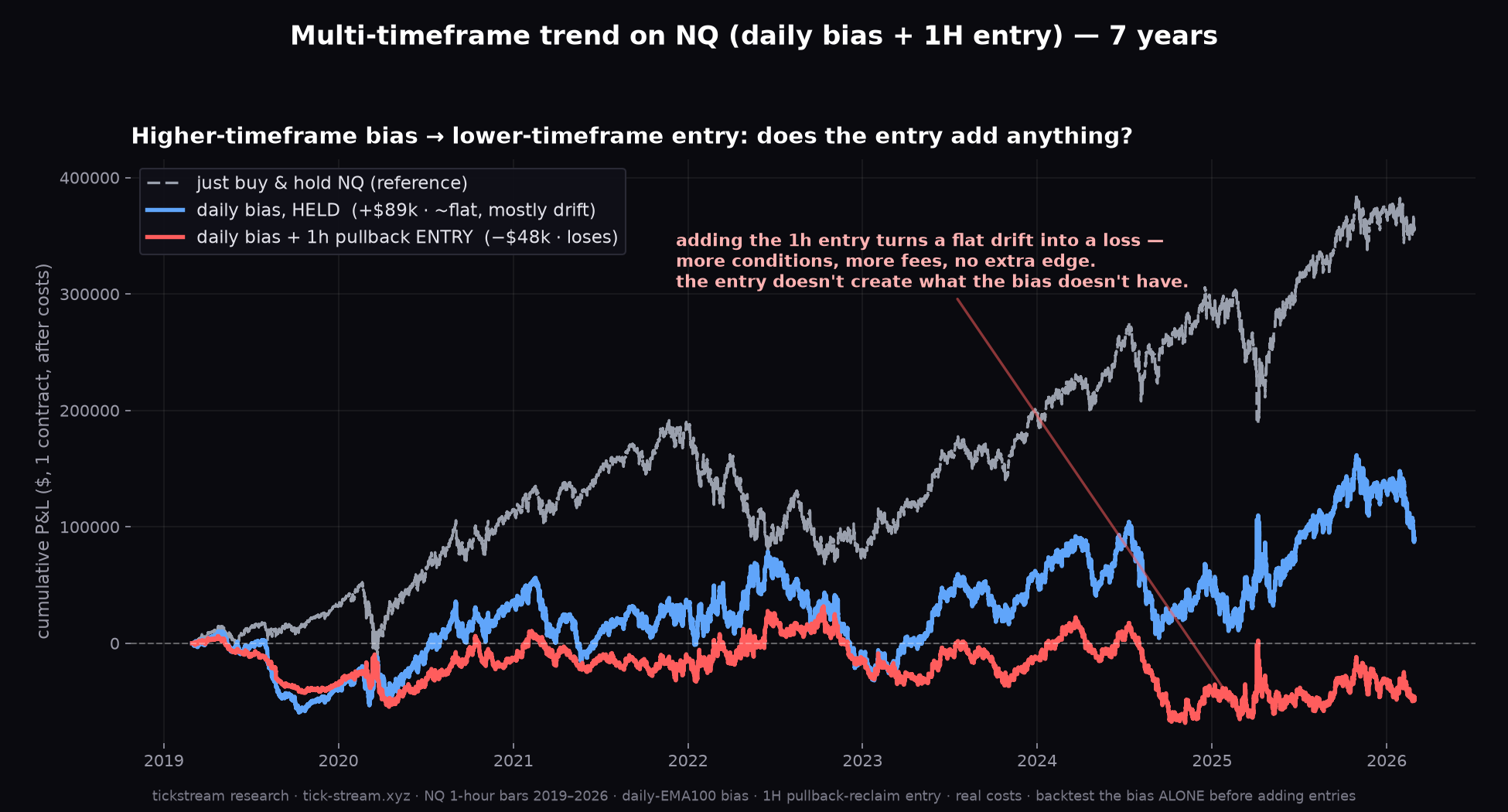
| Arm | 7-year net (1 contract, after costs) |
|---|---|
| Buy & hold NQ (reference) | +$357k |
| Daily bias, held | +$89k |
| Same bias + 1H pullback entry | −$48k |
The identical directional information, passed through a “precision” execution layer, went from +$89k to −$48k. The entry didn’t refine the edge. It deleted it, then went negative on friction.
Why the entry subtracts
1. It skips the best days by construction. The strongest trend legs — the handful of days that pay for the whole year — run away without ever giving the hourly pullback. The entry filter’s real function is deselecting exactly the trades the bias exists to catch. (We found the same anatomy in the IB60 first-hour strategy and the opening-range study: the pullback-entry layer always samples the weak subset.)
2. It multiplies friction. One held position becomes dozens of round trips. Each is small; 7 years of them is a five-figure toll.
3. It concentrates fills in chop. An hourly pullback-and-reclaim fires most reliably in rotation — which is precisely the regime where the daily bias is least informative. The entry doesn’t just sample the weak trades; it oversamples the weak regime.
What the bias alone is actually worth
Honesty cuts both ways: +$89k is well under buy-and-hold’s +$357k. The daily bias’s genuine value isn’t return — it’s that it stood aside through the worst of 2022, cutting the drawdown far below buy-and-hold’s. Daily trend persistence on NQ is real (it’s one of the few effects that has survived every test we’ve thrown at it, and it’s the basis of our live trend strategies) — but it’s a regime and risk tool. Modest, robust, useful. The mythology is in the entry layer, not the bias.
The transferable rule
Backtest the bias alone first. It’s the control group every multi-timeframe system needs and almost none get. If the bias has no edge, no trigger can create one — a lower-timeframe entry can only time information that already exists. And if the bias does have an edge, make every added layer prove it adds net value after costs. In seven years of NQ data, the most-taught refinement in trading failed that test by $137k.
Methodology: NQ 2019–2026, 1 contract, $4.50 commission + 2 ticks slippage per round trip. Bias: daily close vs 100-day EMA, long/flat, evaluated on daily closes. Entry arm: same filter, positions opened only on 1-hour pullback-to-reclaim triggers with matching intraday exit logic, conservative bar resolution (stop before target).
Frequently asked questions
Does combining a higher-timeframe bias with a lower-timeframe entry improve results?
Not in our test — it inverted them. On seven years of NQ, holding a simple daily-trend bias (price vs. its 100-day EMA) earned +$89k on one contract after costs. Taking the SAME bias but entering only on 1-hour pullback-and-reclaim setups earned −$48k. The lower-timeframe entry layer subtracted about $137k from the identical directional information.
Why would a 'better entry' make a strategy worse?
Three compounding reasons. Selection: the strongest trend legs never give you the pullback, so the entry filter systematically skips the best days and keeps the choppy ones. Friction: many small entries and exits multiply commissions and slippage. Timing: an hourly pullback-reclaim fires most often in rotation, right before the next leg of chop. The daily bias contains the edge; the hourly trigger samples the worst subset of it.
Is the daily-trend bias itself worth trading?
It's real but modest — and mostly drift. +$89k over 7 years on one NQ contract is far below buy-and-hold's +$357k over the same window, because the bias filter takes you out of the market during high-volatility bear phases (which cuts drawdown substantially — that's its actual value). Trend persistence at the daily level on NQ is one of the few effects we've repeatedly validated; it's the foundation of our live trend strategies. But it's a position-sizing and regime tool, not a get-rich signal.
What should traders take from this about top-down analysis?
Backtest the bias ALONE before you add any entry logic. If the bias carries edge, the burden of proof is on every additional layer to show it adds net value after costs — in our test it didn't, by a wide margin. Most 'execution refinement' is unexamined subtraction. If the bias alone carries no edge, no entry technique can create one — a trigger can only time information that's already there.