CME · Equity Index
ES historical data
E-mini S&P 500, from 2014-01 to 2026-09 — 153 months of trades, quotes and full book depth. Every figure below is read from the archive itself.
What is in it
| Product | Contents | Size |
|---|---|---|
| Level 1 tape | every trade with size, every best bid/offer change, microsecond stamps | 90.4 GB |
| Level 2 book | 100 price levels per side, as changes rather than snapshots | 54.7 GB |
| 1-minute bars | open, high, low, close and volume built from the real prints | 37 MB |
| Full history | 153 months, 2014-01 to 2026-09 | 145.1 GB |
The S&P 500 contract has the largest Level 1 archive on this list and less Level 2 than NQ — it prints more than it re-quotes, the opposite balance.
What one ES tick is worth
The first thing a coverage table cannot tell you, and the first thing a backtest needs: on ES the minimum price increment is 0.25 index points, which is $12.50 on a contract of $50 × index. Every assumption about slippage in the files below is denominated in that number — a one-tick adverse fill on ES costs $12.50, and a strategy that cannot survive two of them is not a strategy.
Trading hours: Sun 18:00 – Fri 17:00 ET, 60-minute break daily at 17:00. Contract specification from CME; unlike everything else on this page it is quoted rather than measured, because it is a rule rather than an observation.
How ES's archive behaves
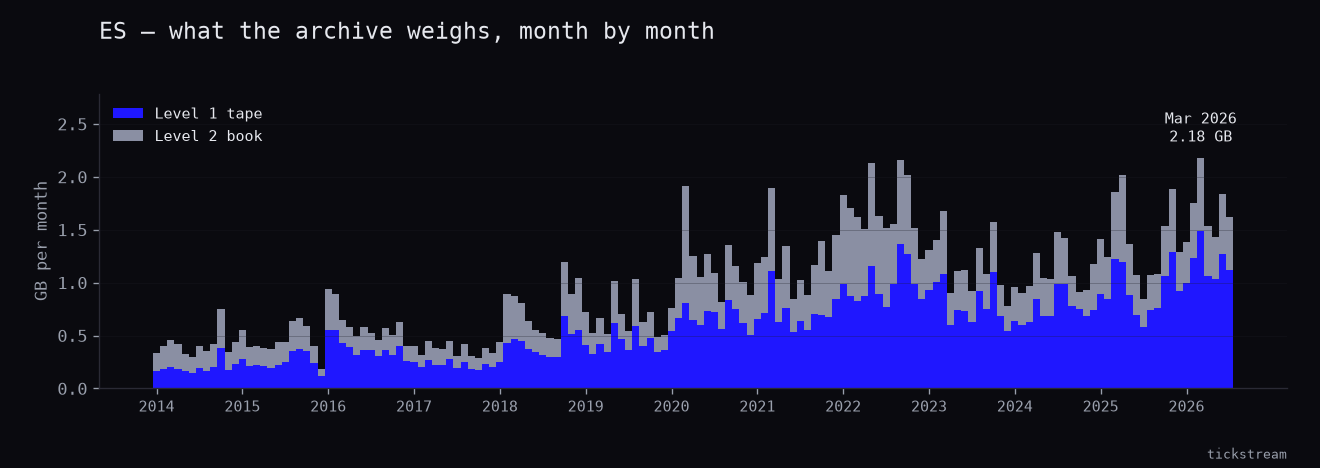
| Book vs tape | 0.60× — the tape carries more bytes than the book. This contract prints more than it re-quotes, which makes fill studies cheap and book-shape studies thin. |
| Heaviest month | March 2026, at 2.18 GB — the month this contract was most active in our whole record. |
| Growth | 3.7× — the last twelve months against the first twelve. Steady enough that the full span is one regime rather than two. |
Why it starts in 2014
Because that is where this contract's electronic record is continuous and trustworthy. We publish the first month that actually answers rather than the first month a catalogue can claim — the same reason our options archive says September 2014 and leaves it there.
An archive that quotes an earlier start and then serves thin or reconstructed months is worse than a shorter one, because the gap only surfaces after a backtest has been built on it.
Format, delivery and what a Level 2 file cannot tell you
Monthly .csv.zst, read directly by DuckDB and pandas, bought once and kept.
The same terms apply to every contract, so they live on
the archive page rather than being restated here — along
with why a market-by-price book contains no order identity, and what
the separate Level 3 product adds.
FAQ
How far back does ES historical data go?
The ES archive starts in 2014-01 and runs to 2026-09 — 153 months, about 12.8 years. That start is where this contract's reliable electronic record begins, not a rounded marketing figure.
What is in the ES Level 1 file?
Every trade print with its size, and every change to the best bid and offer, timestamped to the microsecond. 90.4 GB for the full history. It is the tape, not a sampled snapshot.
What does Level 2 add?
The full book: 100 price levels per side, delivered as changes rather than periodic snapshots, so the book can be reconstructed at any moment instead of at whatever interval a snapshot vendor picked. 54.7 GB for ES.
What format are the files in?
Monthly .csv.zst. DuckDB and pandas read them directly — no unpack step, no per-file password, nothing proprietary to install first.
Do I need a subscription?
No. You buy the years you need once and keep them. A $10/month option appends each new session as it closes, and cancelling it leaves everything already paid for in place.