Databento vs tickstream: An Honest Comparison of Two CME Data APIs
Databento bills by the gigabyte or from $199/month; we bill $29–$199 by use case. A side-by-side on coverage, pricing model and what each is actually built for — including the cases where Databento is the better buy.
Two ways of selling the same underlying exchange data, built for different people. This is a straight comparison, written by one of the two — so the section on when to pick the other one is longer than the section on when to pick us.
All Databento figures below are from their public pricing page, retrieved 2026-08-28. Everything about our side comes from our own catalogue. Nothing here is inferred about their internals.
The short version
| Databento | tickstream | |
|---|---|---|
| Pricing model | usage-based per GB, or subscription | flat monthly by use case |
| Entry price | $125 free credits, then $/GB | $0 free tier, then $29/mo |
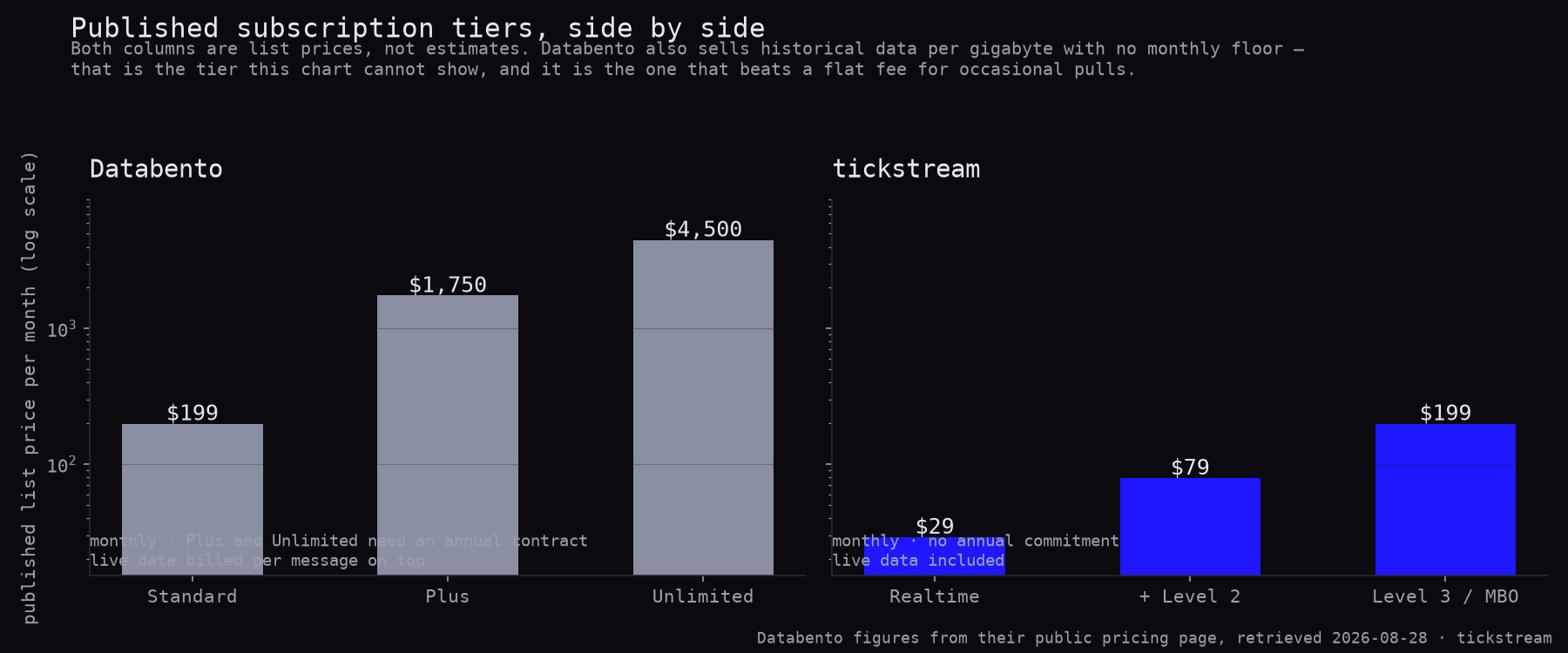
| Subscription tiers | $199 · $1,750 · $4,500 per month | $29 · $79 · $199 per month |
| Annual contract required | on Plus and Unlimited | never |
| Live data billing | per message, plus pass-through licence fees | included in the flat fee |
| Venue coverage | many, across asset classes | CME Group futures + US options |
| Built for | data infrastructure at scale | one developer, one use case |
Where the two models actually differ
Databento bills by consumption: historical data at a rate per gigabyte of uncompressed binary, live data per message on top of pass-through licence fees. Their subscription tiers start at $199/month (Standard, monthly billing) and rise to $1,750 (Plus) and $4,500 (Unlimited), the upper two requiring an annual contract.
We bill by what you are doing, flat: $29/month for realtime CME futures, $79 with Level 2 depth, $199 for Level 3 market-by-order. Options are separate at $29/$69/$119, gamma analytics at $29/$39/$69. No annual commitment on any of them.
Neither model is better. They fail in opposite directions.
Usage-based fails when you iterate. A researcher re-pulling the same range while tuning a script pays each time. The meter is running while you think.
Flat fails when you barely use it. If you need one month of one symbol, once, a flat monthly fee is worse than a per-gigabyte charge that might come to a few dollars — and Databento’s $125 in free credits may cover the whole job at zero cost.
That is not a rhetorical concession. It is the single most useful sentence in this article: if your usage is occasional and historical, we are the wrong shape.
Coverage: they have more
Databento’s published coverage spans many venues across equities, options and futures under one normalised schema. That breadth is their product.
Ours is narrow on purpose: CME Group futures — CME, CBOT, NYMEX, COMEX — plus US index and equity options, with twelve years of options history and seven years of futures ticks. If you need Nasdaq equities, or European venues, or crypto exchanges under the same interface, we do not have them and are not building them.
A useful test: count the distinct venues your project touches. At one, our shape works. At three or more, a normalised multi-venue feed is worth paying for, and switching later costs more than starting there.
Where we have more, honestly scoped
Three things, and all three are built on top of data rather than more data:
Dealer gamma as a served product. Not raw chains you model yourself — computed GEX per strike, call and put walls, the zero-gamma flip, DEX, vanna and charm, with the method published and the levels free to look at. Anyone with option chains can compute this; the difference is whether you want to own that code.
An MCP server. An LLM can query the data directly, documented here. Useful if your workflow already runs through Claude or a similar assistant.
Execution on the same key. Orders through Rithmic alongside the data feed, at $19/month. A data vendor is not usually also an execution path.
None of these change who has more market data. They change what you can do without writing the layer yourself.
When Databento is the better choice
Four cases, and we would rather you recognised yourself in one of them than churned off us in a month.
You are pulling large historical ranges occasionally. Per-gigabyte with $125 of free credits will beat any flat fee for a one-off study. Use them.
You need more than CME. Multiple venues under one schema is their design goal. Assembling that from narrow vendors is a job, and it is not a job worth doing to save $50 a month.
You are building data infrastructure rather than a strategy. Their tiers scale into the thousands per month because the product is designed to sit under something large. Ours tops out at $199 because it is designed to sit under one person’s work.
You need a normalised schema across asset classes. Cross-venue normalisation is genuinely hard, and a vendor who has already solved it is worth paying for.
When we are the better choice
You trade CME futures and want the meter to stop. A flat fee means iterating costs nothing extra, which matters more than the headline rate when you are still figuring out what you are building.
You want the gamma layer without writing it. Chains are the input; walls, flip and regime are the output. If the output is what you need, buying the input and building the middle is weeks of work.
You want one key for data, analytics and orders. Fewer vendors, fewer contracts, fewer things to reconcile at month end.
The two sentences
If your project is broad, occasional or infrastructural, Databento is the better fit and their free credits will tell you cheaply.
If it is CME-shaped, continuous, and you would rather buy the analytics layer than build it, that is the case we are built for — and you can test the whole thing free before deciding.
Comparison written by tickstream, August 2026. Databento is a trademark of its respective owner, referenced descriptively; we are not affiliated with or endorsed by them. All Databento figures are from their public pricing page retrieved 2026-08-28 and may change — verify current terms with them directly. Nothing here is financial advice.
Frequently asked questions
Is tickstream cheaper than Databento?
It depends entirely on volume, and for large historical pulls Databento is often cheaper. Their usage-based tier charges per gigabyte with no floor, so a one-off research download can cost a few dollars. Ours is a flat monthly fee by use case — $29 for realtime CME futures, $79 with Level 2, $199 for Level 3. Flat pricing wins when you pull continuously; per-gigabyte wins when you pull rarely.
Does Databento cover more markets?
Yes, considerably. Their published coverage spans many venues across equities, options and futures. Ours is CME Group futures (CME, CBOT, NYMEX, COMEX) plus US index and equity options. If you need multiple asset classes under one normalised schema, that is their design goal and not ours.
What does tickstream have that Databento does not?
Three things, all narrow: computed dealer gamma exposure as a served product rather than raw chains you model yourself, an MCP server so an LLM can query the data directly, and order execution through Rithmic on the same key. None of those are data-coverage advantages — they are things built on top of a smaller dataset.
Which should I choose for a backtest?
If the backtest is a one-off over a wide date range, Databento's per-gigabyte historical tier is likely the cheaper and better-normalised route. If you are iterating daily on CME futures and want the same key to also stream live and place orders, the flat fee stops the meter running while you work.