Do Our Strategies Work in Asia and London? We Audited Our Own Book — and Killed Two of Our Own Algos
A subscriber-grade question turned inward: every backtest we publish anchors to the New York open. So we rebuilt seven years of full 23-hour Globex bars from our own tick store and re-ran our validated sleeves on the Asia and London sessions — same rules, same honest fills, same costs. The NY edges do not travel. And the audit caught something worse: one of our own live strategies was standing on a gap-fill artifact. It's coming off the board.
A reader-grade question landed on our own desk this week: everything you publish anchors to the New York open — did you ever test anything in Asia or London?
Honest answer: no. And it wasn’t an oversight in one study — it was structural. Our canonical research bar store was built RTH-only (the filter is one line: mod >= 570 & mod < 960), every intraday sleeve on the live board gates itself to 09:30–16:00 ET, and the one session-aware study we ever ran was a debunk of someone else’s claim. So we treated it like any other claim that walks in the door: rebuilt the data, ported the rules, ran the tests. Seven years, full 23-hour Globex coverage, 2.4 million one-minute bars from real trade prints.
The audit answered the question — and then it did something audits are supposed to do and almost never do: it caught one of our own live strategies standing on an artifact.
The sessions, measured first
Before testing strategies, know the terrain. Three sessions in exchange time: Asia 18:00–03:00 ET (Globex reopen through the pre-London hours), London 03:00–09:30 ET, NY 09:30–16:00 ET.
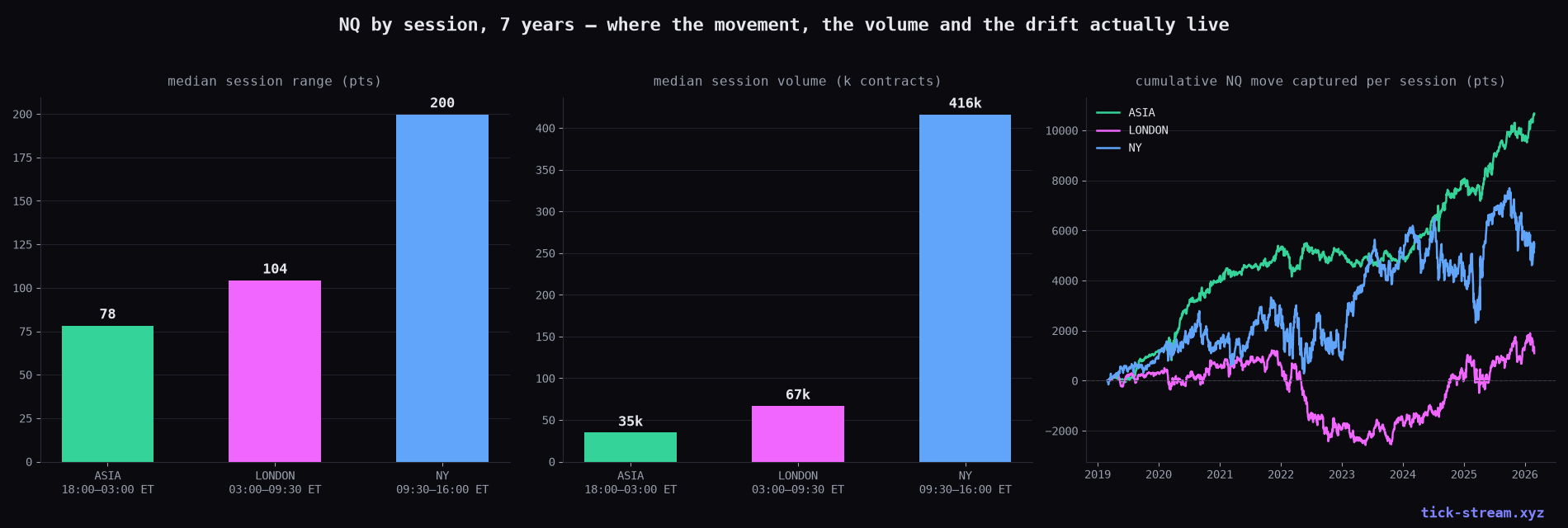
Three facts set the stage:
- NY owns the movement: median session range 200 points, versus 104 in London and 78 in Asia.
- NY owns the liquidity: 416k contracts median, versus 67k (London) and 35k (Asia) — a 12:1 ratio against the Asia session.
- But the drift lives overnight. Cumulative close-minus-open per session over seven years: Asia +10,800 points, NY +5,500, London roughly zero. The famous overnight-drift effect is alive in NQ — the index does much of its rising while America sleeps, on thin volume. That’s harvested by holding (which our daily sleeves do), not by trading against a 2–3 tick overnight spread.
Same rules, three sessions
We took three validated NY sleeves — the 30-minute opening-range breakout (Daybreak), the wicked-low trend-pullback (Wickline), and the displacement-retrace system (Slingshot) — and re-anchored the exact same rules to each session’s open: the opening range becomes the first 30 minutes after 18:00 or 03:00, “flat at the close” becomes flat at the session’s end, everything else identical. Honest fills throughout: stop-before-target, targets only from the bar after entry, entries at max(level, open) plus slippage, $14.50 round trip.
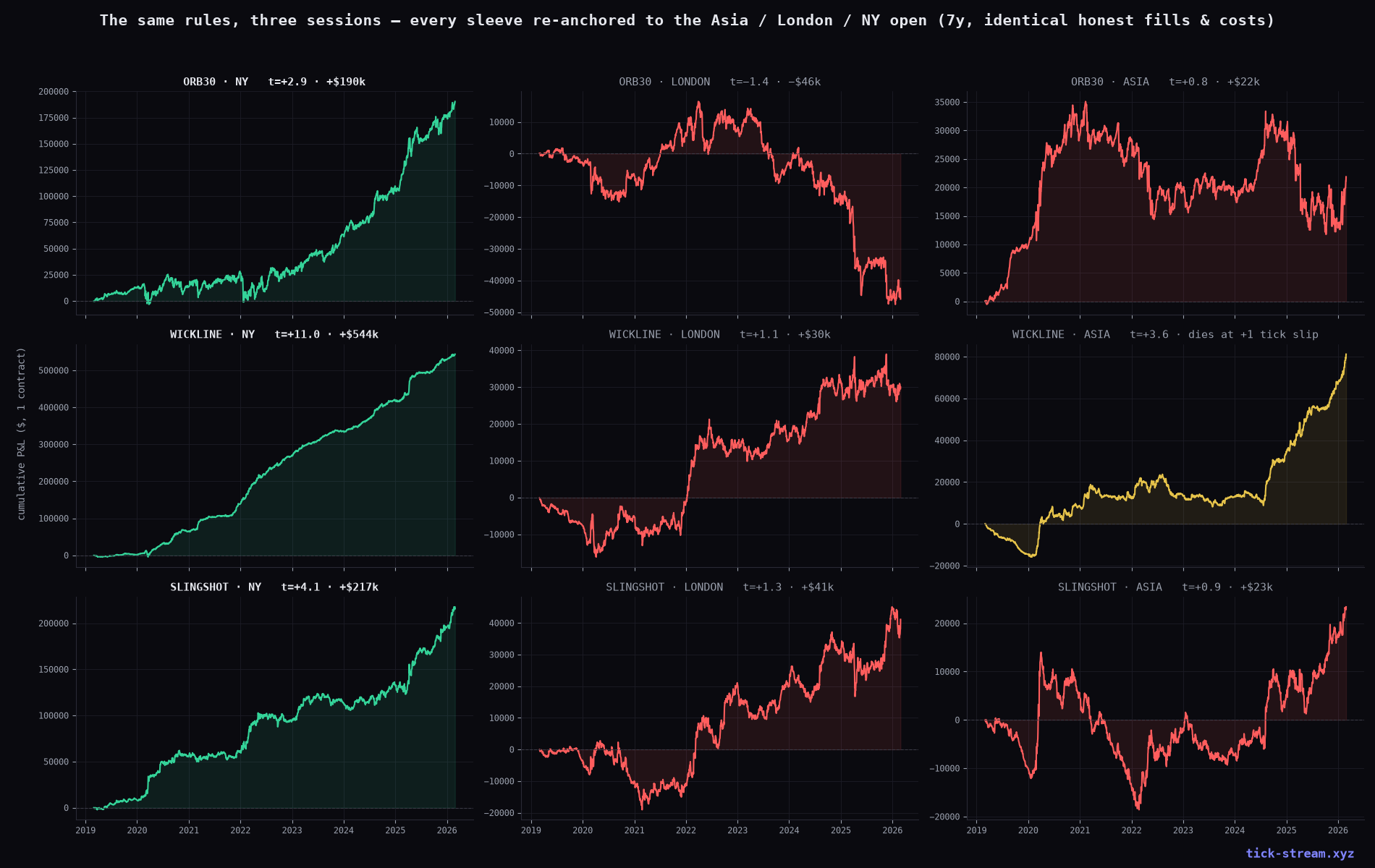
| Strategy | NY (baseline) | London | Asia |
|---|---|---|---|
| ORB30 breakout | t = +2.9 · +$190k | t = −1.4 · −$46k | t = +0.8 · +$22k |
| Wickline pullback | t = +11.0 · +$544k | t = +1.1 · +$30k | t = +3.6 · +$81k* |
| Slingshot retrace | t = +4.1 · +$217k | t = +1.3 · +$41k | t = +0.9 · +$23k |
The left column replicates. The middle column — London — is the graveyard: nothing is significant and the ORB actively loses. The right column has one asterisk worth explaining.
Wickline/Asia is statistically real and economically dead. t = 3.6 over 10,590 trades looks like a discovery until you read the per-trade line: $7.67 average profit — about 1.5 ticks. Add one tick of extra slippage (overnight NQ spreads run 2–3 ticks against RTH’s one) and the t-stat collapses to 1.26; add two and it’s negative. The NY version shrugs off the same stress (t = 9.4 even with two extra ticks, $69 per trade). Same shape as our order-book-imbalance finding: a pattern can be genuinely present and still belong entirely to whoever pays no spread.
The part we didn’t expect: our own artifact
To port our fourth intraday family — the NR4/NR5 volatility-contraction breakout (the Coil sleeves) — we went back to its validation battery. And found that the dataset behind it covered roughly an 8-hour day window, with the next day’s breakout test starting after 17 untested overnight hours — and entries booked at the level even when the session opened far beyond it. Every overnight gap through the level was silently credited as profit.
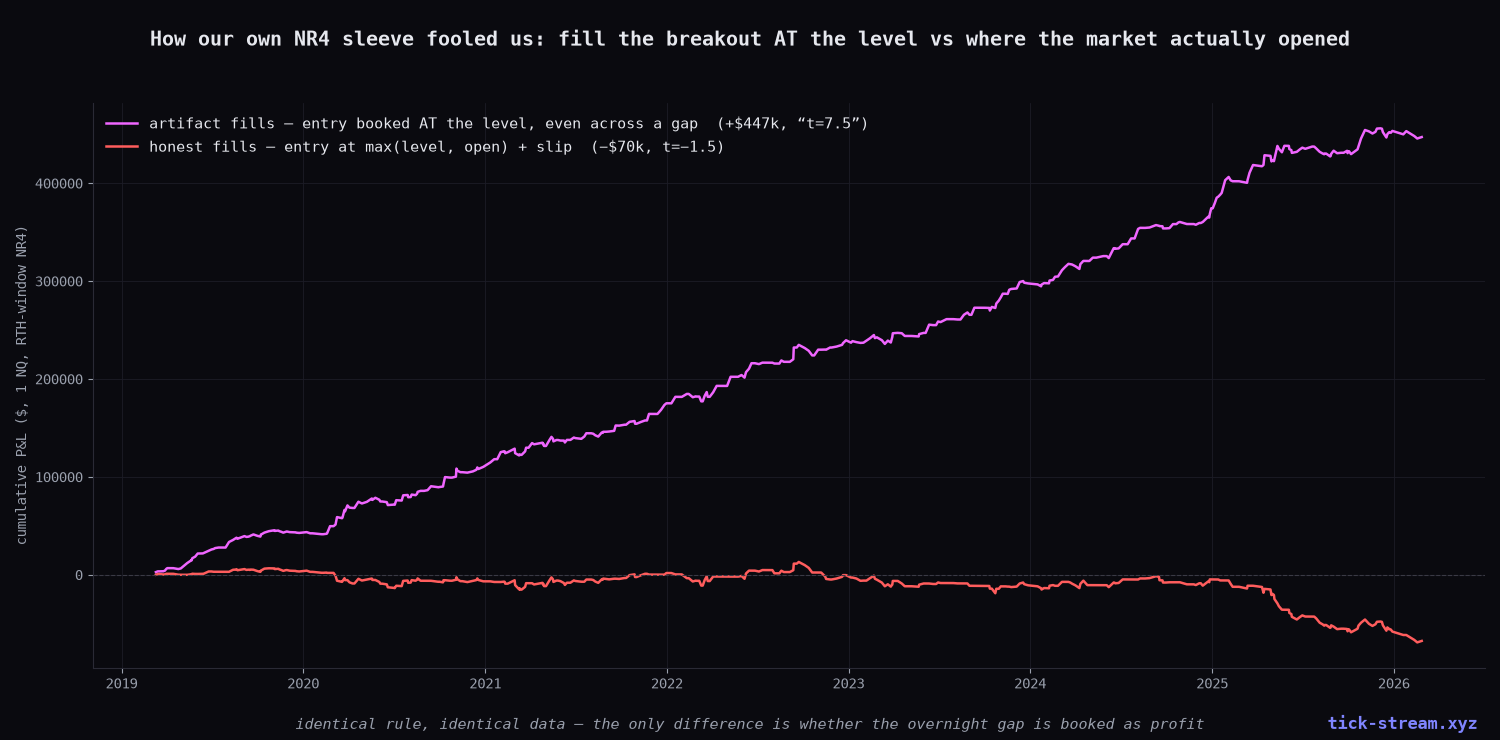
Same rule, same data, one line changed — entry = max(level, open) instead of entry = level:
- Artifact fills: +$447k, “t = 7.5” — a career-making equity curve.
- Honest fills: −$70k, t = −1.5.
- The clean canonical version (true 18:00→17:00 Globex trading days, no artificial gaps anywhere, both NR4 and NR5): t = −0.6 and −0.25. There is no narrow-range breakout edge on NQ. There never was.
This is the exact artifact family we’ve used to debunk other people’s backtests — the rejection-block study, the level-fill ORB variants. This time it was ours. The Coil NR4 and NR5 sleeves are being retired from the live board: their live records were six weeks and a handful of trades — far too little to contradict seven years of honest arithmetic, and today they lost money doing exactly what the honest backtest predicts.
If you rent or follow our algos: this is what the paper forward-test period is for. Every sleeve trades publicly on live data precisely so that errors like this surface and get owned in public, not buried in a methodology appendix.
Why the edges don’t travel
The pattern across all twelve tests is consistent and mechanical, not mystical. Intraday edges are paid out of movement, and they pay friction per trade. NY offers 200 points of median range against a 1-tick spread; Asia offers 78 points against a 2–3 tick spread. The same pullback that clears its costs eight times over in NY clears them 0.6 times in Asia. London is worse than its numbers suggest: it has half of NY’s range but none of its follow-through — the ORB result (t = −1.4) says London breakouts are faded, not followed, presumably because the session’s job is positioning ahead of the US data drops rather than trending.
And the one thing the overnight sessions genuinely offer — the drift — is already in the book. Our daily sleeves hold through Asia and London every night by design; they’ve been harvesting that +10,800 points the entire time. The audit’s conclusion isn’t “ignore the overnight” — it’s that the overnight rewards holding beta, not trading setups.
What changes on our side
- Coil NR4 and NR5 are off the live board. No honest formulation of the edge survives (23h Globex days: t = −0.6; RTH: t = −1.5; Asia-only: t = 1.35, not significant) — there is nothing to fix, so there is nothing to sell.
- The full-session bar store is now permanent research infrastructure — every future backtest gets an Asia/London robustness pass alongside the cost stress.
- Every backfilled June trade was re-verified against the tick store. The same sweep found three more fabricated fills hiding in the June backfills of two other sleeves — including a +$15.4k “win” whose entry level the market never came within 500 points of touching (it was a stale pre-outage level, gap-booked). All three are removed from the live records; Surge’s live P&L drops by $21.8k. Every remaining fill on the board has now been verified against actual prints.
- No session-variant products. We seriously considered shipping “Daybreak-London” and “Daybreak-Asia” sleeves — a session switch on the algo board. The data said no, so there’s nothing to sell. That sentence is the entire reason to run audits like this one.
Methodology: 7 years of NQ (2019-03 → 2026-02), 1-minute bars built from real trade prints in our own tick store (aggressor via quote rule, documented provenance), full 23h Globex coverage, 2,089 trading days. Sessions defined in ET (DST-safe). Ports use each sleeve’s validated parameters unchanged; fills: stop-priority within bars, targets only from the bar after entry, breakout entries at max(level, open) + 1–2 ticks slip, $14.50–$9 RT per the original batteries. Cost stress: +1 and +2 ticks per trade on overnight sessions. Full audit trail, scripts and per-session daily P&L series archived.
Frequently asked questions
Do NY-session trading edges work in the Asia or London session?
In our tests: no. We re-anchored three validated NY-session strategies (a 30-minute opening-range breakout, a trend-pullback system, and a displacement-retrace system) to the Asia open (18:00 ET) and London open (03:00 ET) with identical rules, honest fills and identical costs over seven years of NQ. New York: t-statistics of +2.9, +11.0 and +4.1. London: −1.4, +1.1, +1.3 — nothing survives. Asia: +0.8, +3.6, +0.9 — and the one statistically significant result dies the moment you add a single tick of extra slippage, which is less than the real overnight spread.
Why do intraday edges concentrate in the New York session?
Structure, not folklore. The NY session carries a median 200-point range on 416k contracts of volume; Asia is 78 points on 35k, London 104 on 67k. Intraday strategies earn multiples of their friction: the same pattern that nets 14–70 ticks per trade in NY nets 1–2 ticks in Asia — smaller than the session's own spread. The statistical pattern can exist overnight (our pullback system shows t=3.6 in Asia) and still be untradeable, because the margin is inside the friction.
Which session actually drives NQ's returns?
The overnight one — but as drift, not as strategy alpha. Over seven years the Asia session (18:00–03:00 ET) accumulated about +10,800 NQ points of close-to-open movement, more than the NY session's +5,500, on a fraction of the volume. London accumulated roughly zero. That is the well-documented overnight-drift phenomenon: you harvest it by holding, not by trading — which is exactly what our daily sleeves do.
What is a gap-fill artifact in a backtest?
Booking a breakout entry AT the level even when the market never traded there on the way in — for example when the session opens far beyond the level after an overnight move. The backtest credits the whole gap as profit. Our own NR4 volatility-contraction sleeve was validated on a day-session dataset with 17 overnight hours between windows: with artifact fills it shows +$447k and a t-stat of 7.5; with honest fills (entry at max(level, open) plus slippage) the same rule loses $70k. We are retiring the sleeve.
How do you test whether a strategy is session-robust?
Rebuild your bars for the full 23-hour session (our vendor tape covers all of Globex), define sessions in exchange time so DST can't shift them, re-anchor the exact same rules to each session's open, and keep fills honest: stops before targets, targets only from the bar after entry, entries at max(level, open) — never at the level across a gap. Then stress the survivors with extra slippage scaled to that session's real spread. A session edge that only exists at RTH spreads is an NY edge.