Does the NY Opening-Range Breakout Actually Work? We Tested Every Version on 7 Years of NQ
Fade the opening range for an 81% win rate, or trade the breakout for easy money — the NY ORB is one of the most-sold day-trading strategies online. We tested every version on 7 years of NQ futures, lookahead-free with real costs and a train/holdout split. The result isn't a clean debunk: the popular versions are invalidated, but one version holds up as a thin, real edge. Here's the full data.
The NY opening-range breakout might be the single most-sold day-trading strategy on the internet. The pitch comes in two flavours: “fade the opening range for an 80%+ win rate,” and “trade the breakout of the first 15 minutes for easy trend days.” Both are everywhere, both look great in marked-up screenshots. So we did the boring thing: we tested every version on seven years of NQ futures and let the data sort the myth from the real.
The result is the most nuanced one we’ve published. It is not a clean debunk — but the two versions retail actually trades are the two that don’t work.
What we tested
We defined the opening range as the first 5, 15, 30 or 60 minutes after the 09:30 ET cash open, then ran the full matrix:
- Breakout — first 5-minute close beyond the range high (long) or low (short); stop at the other side of the range; exit at the close (ride it) or at a fixed reward multiple.
- Fade — short the break above the range / buy the break below it, targeting the range mid (the mean-reversion version).
- Fixed-target breakout — the famous “10-point take-profit, 81% win rate” variant.
- Trend-filtered breakout — only take the break that aligns with the overnight gap direction.
How we made the test un-arguable
- NQ 5-minute bars, 2019 → 2026 (~7 years).
- Lookahead-free. Signals use only the completed opening range and already-closed bars.
- Conservative fills. On the entry bar only the stop can trigger; targets fill from the next bar onward. No intrabar fill fiction.
- Real costs. $4.50 commission + 2 ticks of slippage, extra slippage on stops.
- Train / holdout split (2019–2023 vs 2024–2026).
(We also caught and fixed a bug in our own first pass: the fade variant’s stop was placed on the wrong side of the entry, which made it look like a 33-sigma, profit-factor-50 monster. It wasn’t real — it was a misplaced stop booking every exit as a win. If you don’t hunt your own results harder than your critics will, a backtest proves nothing.)
(Follow-up, July 2026: a reader sent us a fully specified ORB30 long-only variant — wide 2.25×OR stop, small 0.75×OR target, flat by 17:00. It survived the full battery, including two placebo controls and a parameter grid — the ORB30 backtest is here.)
Myth 1: “Fade the opening range” — loses
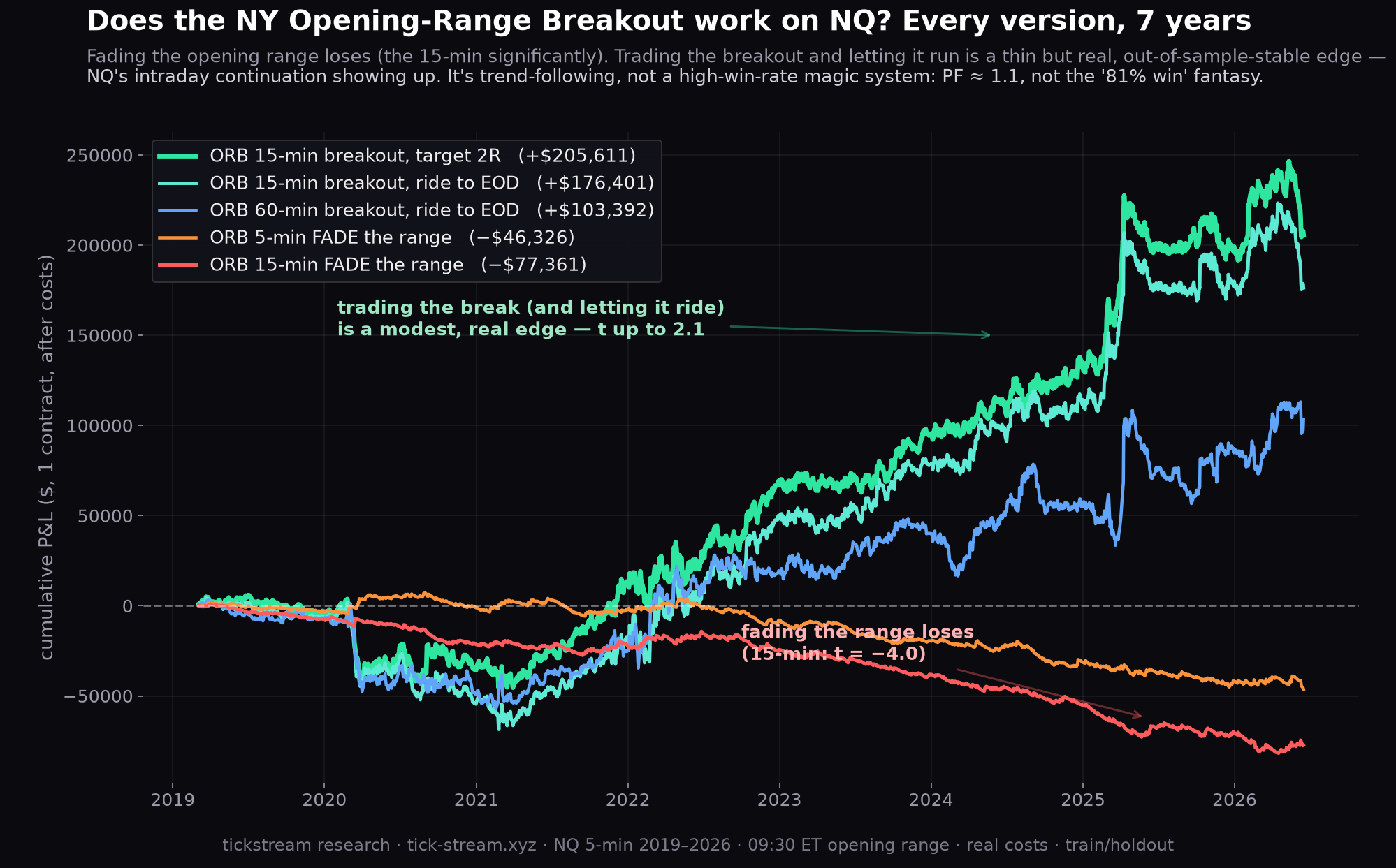
A quick note on t (the t-statistic), the number in every table below: it measures how far a result sits above zero relative to its own noise (how many standard errors). |t| above 2 means less than a ~5% chance it’s luck — a real result; −2 to +2 is indistinguishable from random; negative means it lost. So t = −4.0 below isn’t just “didn’t work” — it’s a reliable loser.
Fading the opening range — the mean-reversion version that promises a high win rate — loses in every range size, and significantly at the 15-minute range:
ORB  5-min  fade → mid    −$46,326    t = −2.46
ORB 15-min  fade → mid    −$77,361    t = −4.00   (significant loser)
ORB 30-min  fade → mid    −$38,810    t = −1.70
ORB 60-min  fade → mid    −$35,772    t = −1.61
The reason is simple: NQ trends intraday. When price makes a real move out of the opening range, fading it means betting against the trend, and the level breaks and runs far more often than it gets absorbed back to the mean. This is the same structural fact that kills value-area fades, VWAP reversion and level-reaction setups on NQ.
Myth 2: “81% win rate” — breakeven
The viral version uses a breakout entry with a fixed 10-point take-profit and a stop at the opposite side of the range. We’ve tested this exact construction: on NQ it wins ~88% of the time — even higher than advertised. And it makes almost nothing. The average win is ~$185; the average loss (a full-range stop) is ~$1,400. The arithmetic is brutal: 88% × $185 ≈ 11% × $1,400. The rare big losses cancel the many small wins almost exactly, and profit factor lands at ~1.01 — a coin flip with commissions. High win rate is the hook, not the edge. A tiny fixed target throws away the one thing that makes the breakout work: letting the trend run.
The real version: trade the breakout and let it ride
Here’s the part that isn’t a myth. Take the breakout, stop at the other side of the range, and let it run to the close (or to a sensible 2R), and you get a thin but genuine edge — strongest at the 15-minute opening range:
ORB 15-min breakout, ride to EOD   +$176,402   t = 1.69   train + / holdout +
ORB 15-min breakout, target 2R     +$205,612   t = 2.09   train + / holdout +
ORB 60-min breakout + trend filter +$100,321   t = 1.75   train + / holdout +
These survive the honest test: positive in both the train and the holdout period, with real costs and conservative fills. It isn’t huge — profit factor sits around 1.1, not the fantasy numbers in the ads — but it’s real, and it’s the same thing showing up that we see everywhere on NQ: intraday continuation. Once price commits to a direction out of the morning range, it tends to keep going.
The honest verdict
The opening-range breakout is half marketing, half real — and retail trades the wrong half. Fading the range loses. The high-win-rate fixed-target version is breakeven. What actually works is the least-glamorous version: trade the breakout, let it ride, and accept a sub-50% win rate with winners bigger than losers. That’s not an opening-range secret — it’s plain intraday trend-following, and the opening range is just one convenient way to define “the move has started.”
Which is exactly why we don’t trade an ORB as a standalone product. The continuation edge underneath it is real, and we harvest it in a cleaner, more robust form in our live, paper-traded trend and breakout sleeves — without depending on a single arbitrary 15-minute window. If your ORB only works on a marked-up screenshot with a fixed tiny target, you’re selling the win rate, not the edge.
The bottom line
On seven years of NQ futures: fading the opening range loses (significantly at 15 minutes), the “81% win rate” fixed-target breakout is a breakeven coin flip, and the only version with a real, out-of-sample-stable edge is the unglamorous “trade the breakout and let it run” — a thin (PF ~1.1) intraday trend-following effect, best at the 15-minute range. The ORB isn’t a scam, but it isn’t a money machine either. Run any version through costs, conservative fills and out-of-sample data before you believe the screenshot.
Methodology: NQ continuous front-month, 5-minute bars, 2019–2026. Opening range = first 5/15/30/60 minutes after 09:30 ET. Breakout (close beyond range, stop opposite side, exit EOD / 2R / fixed 10pt), fade-to-mid, and gap-aligned trend-filtered breakout. Lookahead-free, $4.50 commission + 2-tick slippage, conservative stop-first fills, 2019–2023 train / 2024–2026 holdout.
Frequently asked questions
Does the opening-range breakout strategy actually work?
Partly. We tested every version of the NY opening-range breakout on seven years of NQ futures, lookahead-free with real costs. Fading the opening range loses money (the 15-minute version significantly, t = −4.0). The popular 'fixed 10-point target, 81% win rate' breakout is essentially breakeven. But trading the breakout and letting it run to the close is a thin, real, out-of-sample-stable edge — best with a 15-minute opening range (t ≈ 2.1, profit factor ~1.1). It's intraday trend-following, not a high-win-rate magic system.
Is the 81% win rate opening-range breakout real?
The win rate is real; the profitability isn't. A breakout with a fixed 10-point target and a stop at the other side of the range wins about 88% of the time on NQ — but the average win is ~$185 and the average loss is ~$1,400, so the rare full-range losses cancel the many small wins almost exactly. Profit factor lands at ~1.01: a coin flip with extra steps. High win rate is the marketing hook; it is not the same as an edge.
Should you fade the opening range or trade the breakout?
On NQ, trade the breakout — don't fade. Fading the opening range (shorting the break above, buying the break below, targeting the range mid) lost in every opening-range size we tested, significantly at the 15-minute range (t = −4.0). NQ trends intraday, so fading the first real move of the day means fading the trend. The breakout side has the edge, not the fade side.
What's the best opening range length — 5, 15, 30, or 60 minutes?
The 15-minute opening range was the most robust in our test, with the breakout reaching t ≈ 2.1 and staying positive in both the 2019–2023 train period and the 2024–2026 holdout. The 5-minute range is too noisy (lots of false breaks), and the 30/60-minute ranges give back edge by entering late. But even the best version is a modest, thin edge — useful as one input, not a standalone money machine.
Why does trading the breakout work but fading it doesn't?
Because NQ has a genuine intraday continuation tendency: once price makes a real move out of the opening range, it tends to keep going more often than it reverses. That's the same trend-following behaviour our live continuation strategies harvest. Fading assumes mean-reversion intraday, which is false on NQ — the level gets broken and runs, not absorbed back to the mean.