Robert Rother's VWAP Scalping Strategy, Backtested Tick by Tick — Including a Version Where We Cheat For It
An ex-hedge-fund manager describes his method in a 53-minute interview: limit orders at the VWAP, first touch only, 10-tick stop, 10–15-tick target, 80% win rate, trend days only — the trend call is discretionary. We mechanized every rule that can be written down, ran it on 7 years of NQ tick data, and then did something unusual: we deliberately gave the strategy lookahead bias — perfect knowledge of each day's regime — to stand in for his discretion. It loses at every layer, including that one.
This one is different from our usual community submissions, in two ways. First, the source is public and the trader is named: Robert Rother, a former hedge-fund manager (peak $156M AUM, by his own account), who describes his current method in detail across a 53-minute interview — he now trades it on 20–30 funded prop accounts. Second, his strategy contains an explicitly discretionary core, and instead of throwing our hands up at that, we did something we normally never allow in this shop: we deliberately built a lookahead-biased version — the strategy gets to know each day’s true regime in advance — to measure the ceiling of what his discretion could possibly contribute.
Here is the method, condensed from his own description:
Three session VWAPs (anchored 18:00 ET, London open, US open). Trade only trending days — sideways is a no-trade day, and the classification is visual, discretionary. Wait for a pullback to the VWAP. Limit order exactly at the line, first touch only — later touches are materially worse. 10-tick stop, 10–15-tick target, no management whatsoever. Confirmation from the order book: resting liquidity at the VWAP is good, liquidity being pulled (spoofing) is a hard no-trade. Claimed result: ~80% win rate, seconds-to-minutes hold times.
He is refreshingly direct about what is not mechanical: which VWAP is “most respected” today — eyeball. Trend versus sideways — eyeball. What resets a first touch — “I do not believe in these fixed numbers.” And he volunteers that his own automation attempts failed over years, precisely because software couldn’t tell trending from sideways. Keep that sentence in mind; the data will come back to it.
What we built
The 10-tick geometry (2.5 NQ points) is unresolvable on minute bars — stop and target routinely live inside a single bar. So this test runs tick by tick on our NQ trade stream, 2019–2026, ~2,100 sessions: the running VWAP is recomputed on every trade print, a touch only counts after price has genuinely pulled away from the line first, the limit order fills only when a print trades through the level (you are not first in queue), the stop pays a tick of slippage, and the race between stop and target is resolved in actual print sequence — no bar ambiguity, no same-bar fictions. $4.50 round-trip commission, flat by 16:00 ET.
Two disclosures. His instrument is ambiguous in the interview (the chart shown is consistent with YM; he also references ES); we test NQ, where 10 ticks is a much smaller fraction of price — so every result below was also run at a dollar-equivalent 25-tick stop / 30-tick target. And the Bookmap layer — liquidity clusters, the spoofing veto — cannot be backtested by anyone outside an exchange data agreement with historical MBO; we state that plainly rather than pretending to model it.
The ladder: each rung removes an objection
Rung 1 — the raw mechanical core. Every VWAP touch, no regime filter: 35,879 trades, 34.5% win rate against a 51.7% breakeven, −$709,550 per contract, Newey-West t = −26. Not noise; a machine for donating edge.
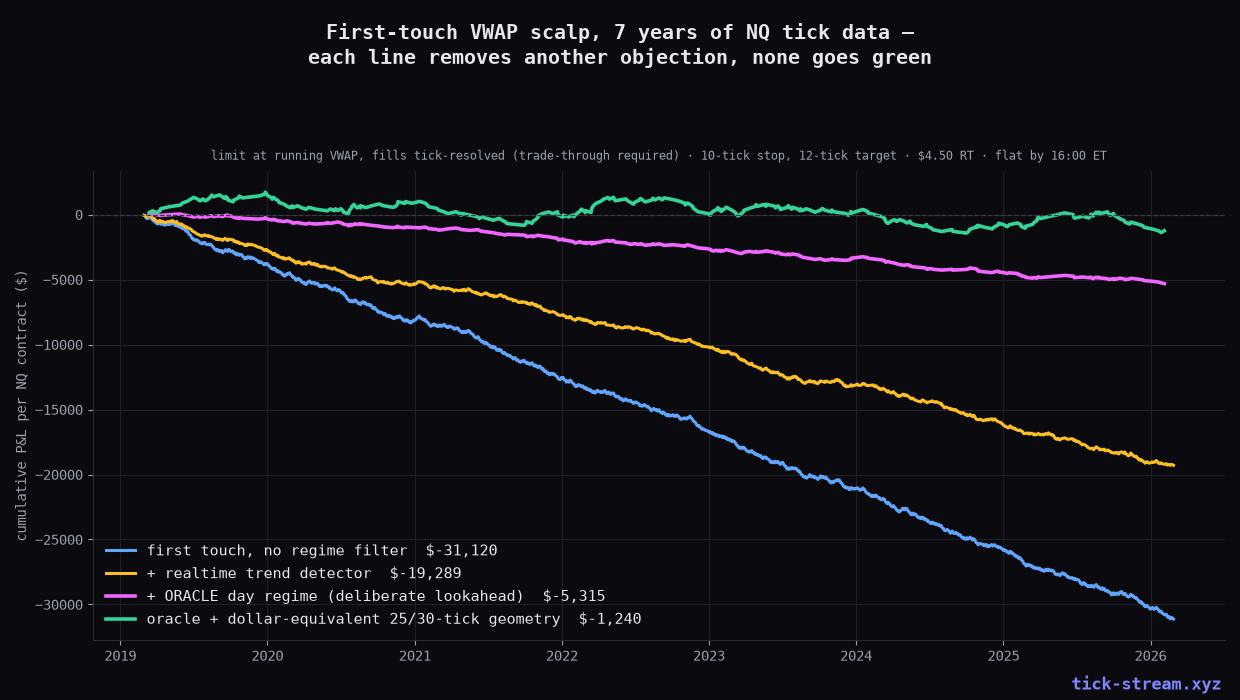
Rung 2 — “first touch only.” This is his A+ rule, and it is directly measurable: first touches win 34.4%, second touches 36.4%, touches one through eight all live in the same 32–37% band. The first-touch rule trades less but not better. −$31,120 on first touches alone.
Rung 3 — an honest real-time trend detector. Price on one side of VWAP ≥70% of the session and VWAP slope agreeing — a reasonable mechanization of “trending market, pullback, continuation.” It removes 40% of trades and keeps losing: −$19,289, t = −11.9.
Rung 4 — the oracle. Here is the part we built specifically for this article. His stated edge is the discretionary regime call, so we replaced it with something better than any human can be: the strategy trades only in the realized direction of days that actually closed directional (|close−open| ≥ half the day’s range — computed from the full day, i.e., pure lookahead). If the discretion is the edge, this version must print money; it holds the answer key.
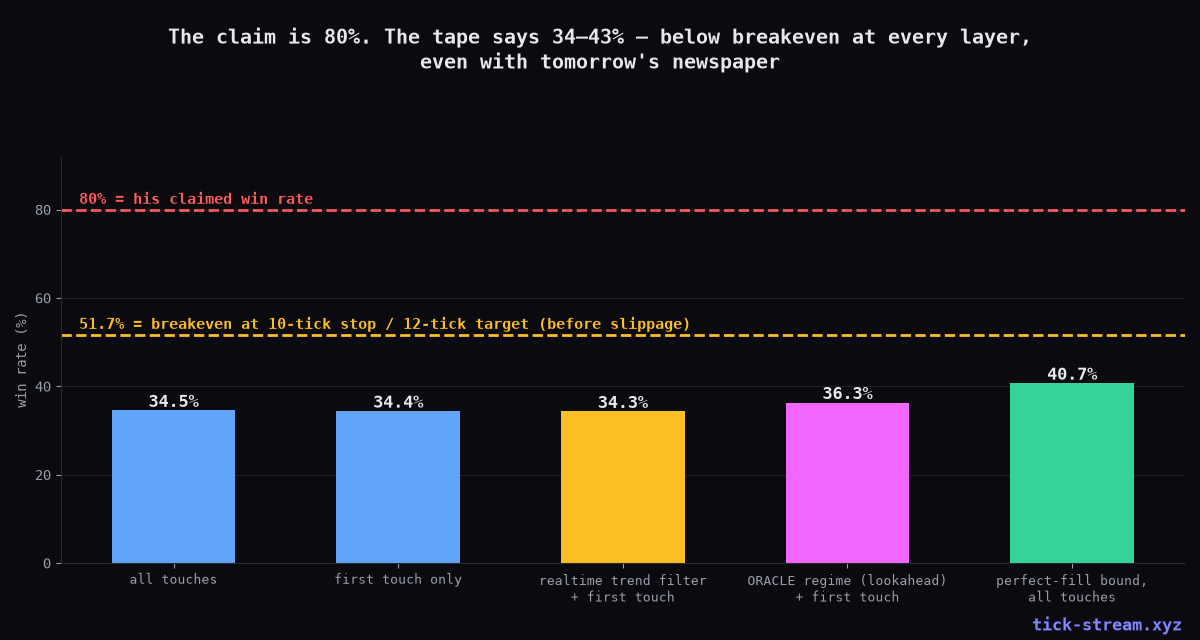
It loses. 36.3% win rate, −$5,315, t = −5.4 at his literal geometry. At the dollar-equivalent 25/30-tick geometry the oracle version achieves the best result in this entire study: an exact zero (−$1,240 over seven years, t = −0.5). Trading against the oracle is measurably worse (32.3%) — so the directional information is real. It just doesn’t matter: even perfect regime knowledge cannot make a limit-at-VWAP scalp with this geometry profitable. The discretion cannot be the edge, because there is no gap for discretion to fill.
Rung 5 — the perfect-fill bound. One objection survives: our trade-through fill rule is conservative; his real edge might be execution — queue position, reading the book. So we ran the physically unbeatable version: every limit fills on a mere touch, every target fills without trade-through. That is strictly better than the best possible real-world execution. It still loses $476,583 across all touches (40.7% win rate). Execution skill has a ceiling, and the ceiling is under water.
Why the entry loses: you’re paid to be adversely selected
A limit order at the VWAP is an offer to buy exactly when the market has enough momentum to trade down through the most-watched mean-reversion line of the session. The fills you get are disproportionately the ones where the pullback doesn’t stop — and with a 10-tick stop sitting 2.5 points behind a magnet price, there is no room to be wrong. That is also the honest reading of the win-rate gap: 80% may well be what a filled-and-managed trade feels like from inside 20 accounts, but 34–43% is what the tape pays a mechanical replica.
His own history agrees with our result more than with his claim. He spent years and serious money trying to automate this and couldn’t — he attributes the failure to regime detection. Our oracle test says the diagnosis was wrong: it fails with perfect regime detection. What’s left to carry the method is the one layer nobody can verify — the order-book read — and what it would now have to carry is not confirmation but a full sign flip of a deeply negative core.
One structural note, stated as arithmetic rather than accusation: the account setup he describes — 20–30 prop accounts, ~$250 daily targets, payouts requested at $500–$1,000, “it’s just an account, if you blow it, open a new one” — is a structure in which aggregate payouts do not require positive per-trade expectancy. Losing accounts reset; winning streaks cash out. We measured the strategy, not the trader; but on our data, the strategy is not where the money comes from.
Verdict
Dead at every layer, including the one we cheated for. The mechanical core loses catastrophically; the first-touch rule is measurably false; a real-time trend filter helps but stays negative; deliberate lookahead — the strongest possible stand-in for 30 years of discretion — still can’t get above zero at the literal geometry and reaches exactly zero at the generous one. The 80% claim is off by more than a factor of two against a breakeven the geometry cannot survive.
The oracle technique is the reusable lesson here, and we’ll use it again: when a strategy hides its edge in a discretionary call, don’t argue with the discretion — replace it with the answer key and see if even that is enough. If perfection loses, every argument about skill is already over.
Update (Aug 16): “it should be ES, not NQ” — okay, here is ES
A reader objected that the strategy belongs on ES, not NQ. Fair — he does reference ES in the interview, and it’s why the original test already included a dollar-equivalent geometry. But we can do better than an equivalence argument: we record ES tick data ourselves. So we ran the identical engine on actual ES trade prints — every session our recording covers (June 10 – August 14, 2026, 38 full sessions), $50/pt, where 10 ticks is now literally his $125 stop.
| Layer (ES, day-anchor VWAP, 10/12 ticks) | n | win% | net | NW-t |
|---|---|---|---|---|
| All touches | 285 | 35.4% | −$11,508 | −5.7 |
| First touch only | 38 | 28.9% | −$2,234 | −3.4 |
| Perfect-fill bound, all touches | 294 | 40.1% | −$7,898 | −3.7 |
| Oracle regime + first touch | 6 | 0% | −$852 | — |
On NQ the same configuration wins 34.5% of all touches; on ES it wins 35.4%. The instrument was never the variable — the geometry is. Two honest caveats: 38 sessions is a small window (the all-touches win rate carries a ±6-point confidence band — which still puts the ceiling nowhere near the 51.7% breakeven, let alone 80%), and the oracle/first-touch rows are too thin on ES to stand alone. They don’t need to; they match a seven-year result.
Our own live, disclosed records are on /algos — including the paper sleeves and the losses. Got a strategy you want put through this machine? Send the full ruleset.
Methodology: NQ front-month tick store 2019–2026 (~2,100 sessions), VWAP recomputed per trade print from the stated anchors (18:00 ET / London / 09:30 ET; results shown for the day anchor, others same conclusion). Touch requires a prior pull-away of ≥20 ticks (≥40 for the 25/30 geometry) from the line; limit fills require a print through the level by one tick (perfect-fill bound shown separately); stop exits pay one tick slippage, plus a 3-tick sensitivity run (worse everywhere, as he himself warns: “fills can come at double the intended stop”); flat by 16:00 ET; $4.50 round trip. The oracle regime label uses the full day’s realized direction and directionality — deliberate lookahead, clearly marked, built to bound the value of discretion. Win-rate/P&L claims quoted from the interview are the trader’s own and unverified. The Bookmap liquidity/spoofing layer and VIX-based sizing are not modeled: historical MBO replay is not available to retail, and we’d rather tell you what we can’t test than pretend we did. This is research, not trading advice.
Frequently asked questions
Does Robert Rother's VWAP first-touch scalping strategy work in a backtest?
Mechanized as described in his interview — limit order at the running session VWAP, first touch only after a real pull-away, 10-tick stop, 12-tick target, no management, flat by the close — it loses money at every layer we tested on 7 years of NQ tick data. All touches: 34.5% win rate against a 51.7% breakeven, −$709,550 per contract. First touch only: −$31,120. Adding a real-time trend filter: −$19,289. Even with deliberate lookahead bias — trading only in the true direction of confirmed directional days, information nobody has live — it still loses $5,315 with a Newey-West t of −5.4.
Is the 80% win rate claim realistic for a 10-tick stop and 10–15-tick target?
Not on our tape. The geometry needs about 51.7% winners to break even before slippage, and every configuration we ran lands between 34% and 43% — including a deliberately generous fill model in which every limit order fills on a mere touch and every target fills without the price trading through it, which is a better outcome than any real queue position can deliver. The 80% figure is the trader's own claim from the interview; nothing in seven years of tick data reproduces it.
Is the first touch of VWAP really better than later touches?
No — that part of the method is directly measurable, and it's false on NQ. Across 1,559 first touches and thousands of later ones, the first touch won 34.4% of the time while the second touch won 36.4%. Touches one through eight all sit in the same 32–37% band. The 'A+ first touch' rule removes trades but does not select better ones.
Couldn't the edge be in the discretionary trend call the backtest can't capture?
That's exactly what the oracle test answers. We replaced his discretionary trend/sideways judgment with deliberate lookahead: the strategy only trades in the realized direction of days that closed directional — perfect regime knowledge that no live trader can have. It still loses at the literal 10/12-tick geometry (−$5,315, t = −5.4), and at a dollar-equivalent 25/30-tick geometry it manages, at best, an exact zero (−$1,240, t = −0.5). Perfect discretion has no room to be the edge, because even perfection doesn't make the trade profitable.
What parts of the strategy can't be backtested?
The Bookmap layer: reading resting liquidity clusters, skipping trades when large orders get pulled (his spoofing filter), and entering in front of visible liquidity. Historical MBO data to replay that doesn't exist for retail, and we say so plainly. But the burden that layer now carries is not 'confirm the entries' — it would have to turn a strategy that loses $710k across all touches into a winner on its own.
Can I submit a strategy to be backtested?
Yes — send the full ruleset through tick-stream.xyz/request-market?topic=strategy. We mechanize submissions exactly as described, run them tick-accurately on 7 years of data with honest fills and real costs, and report whatever comes out.