We Tested Serge Hoffmann's Order-Book Scalping on 7 Years of NQ Ticks — It Loses, and the Order Flow Makes It Worse
Serge Hoffmann teaches order-book scalping: read the volume balance, the speed of the tape, the absorption at the edges, and fade the reversal back to the magnet. We mechanized exactly that on seven years of real NQ trades with honest fills and costs. It loses — 31% win rate, negative expectancy, t = −1.6. And the twist: the absorption-and-speed read that's supposed to be the whole edge makes it measurably worse than fading a random edge with no order flow at all.
Serge Hoffmann doesn’t use charts. He sits in the order book all day and scalps. In an interview making the rounds he walks through his method live: the market, he says, is made of four things — time, price, volume, and speed. Read them together and you don’t need a chart, you build one in your head. Condensed but faithful to what he demonstrates:
Watch the intraday volume profile form a balance — a “D” shape where price ping-pongs between two edges around a high-volume magnet in the middle. Never trade the middle. Trade the edges. When price runs to an edge, read the speed of the tape and watch for absorption — aggressive selling that hits the bid hard but fails to move price, because a bigger passive hand is eating it with iceberg orders. That failure is the reversal: fade it back toward the magnet. Professionals don’t use stops — you exit manually.
Unlike most guru material, this describes real phenomena — absorption, the volume magnet, the speed of aggressive flow are all genuine. So we did the obvious thing: mechanized it and pointed it at seven years of NQ trades, every print with its true aggressor side, and asked whether the story holds.
The setup, mechanized
We rebuilt his read lookahead-free:
- The balance. An expanding intraday volume profile from the cash-session open. The high-volume node is the magnet; a 70% value area around it gives the two edges.
- The trade. When price reaches an edge with absorption (heavy aggressive flow in the trend direction that fails to extend past the edge) and elevated tape speed, fade it back toward the magnet. Target = the magnet. Stop just beyond the edge.
MNQ economics, honest fills, a real round-turn cost. And — this is what actually decides it — we ran it against controls that each strip out one ingredient, so we could see which one carries the money.
It loses. And the order flow is why.
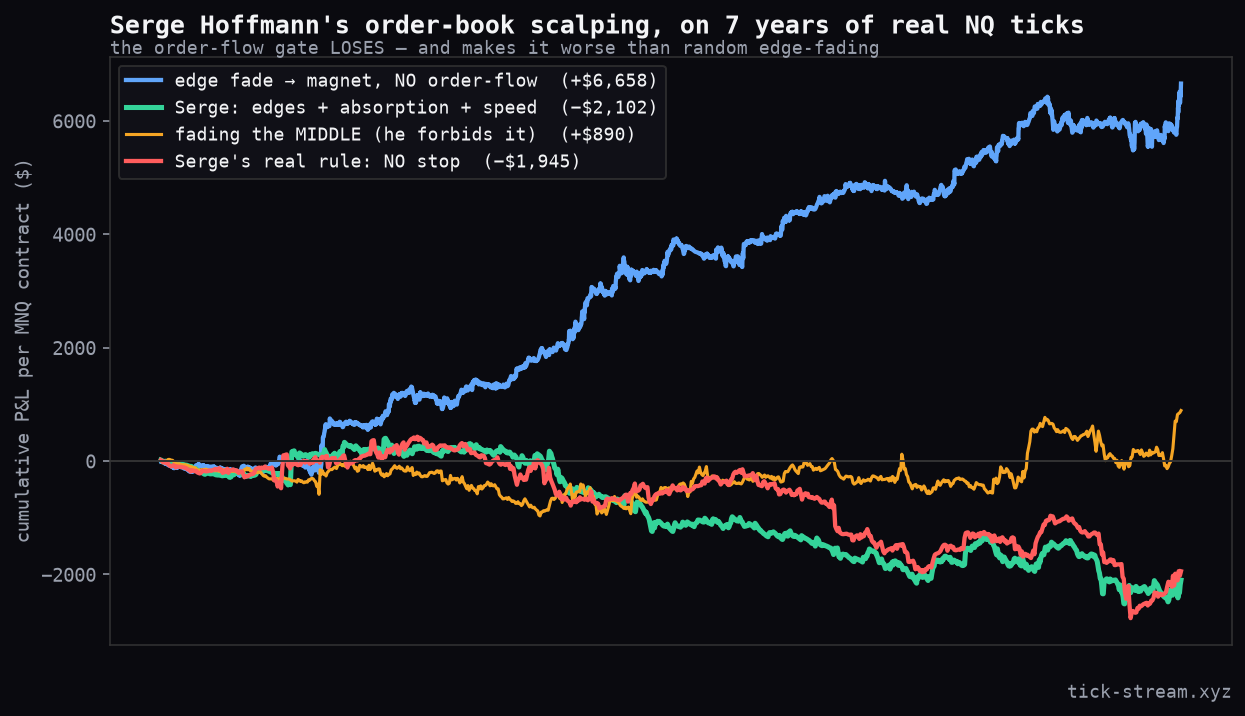
The green line is Serge’s full setup — edges, absorption, speed. −$2,102 per MNQ contract, 31.3% win rate, t = −1.6. It loses, and it sits almost exactly on top of the red line, which is his no-stop rule. His two signature ideas — read the tape, skip the stop — end up in the same place: underwater.
Now the blue line. That’s the same trade with the order-flow read switched off — no absorption, no speed, just fade the edge to the magnet with a stop. +$6,658. It’s the only thing above zero. Which means the absorption-and-speed gate — the entire point of the method — doesn’t refine the entries. It selects worse ones. Reading the book for direction, over seven years of NQ, turned a thin mean-reversion into a losing strategy.
And the thing it’s sitting on isn’t much either. +$6,658 over seven years per micro contract is small, it’s negative in 2025, and fading the middle of the range — which Serge explicitly forbids — nets +$890, a statistical zero (t = 0.55) that’s indistinguishable from his “valid” edge setups. There’s a faint intraday pull back toward the volume node; none of the order-book rules layered on top of it separate winners from losers.
What we could not test — and won’t pretend we did
Two of his most interesting claims are out of reach with our data. The flipping / spoofing play — post large fake orders, let the front-runners pile in, pull the orders, trade the panic — and true iceberg detection both need order-by-order data: every add, modify and cancel. Our archive is trade prints plus aggregated depth, not order-level. So we tested the concept he trades most — absorption at a volume edge, speed of flow — not the microstructure games. They may hold; we can’t adjudicate them, and we’re saying so.
What’s actually true here
None of this makes Serge a fraud. He’s describing real phenomena, and he’s clearly a capable discretionary trader — he even tells you, on camera, that the fast trades go by before he can find his mouse. Discretion, feel, and years of screen time can do things a mechanical rule can’t capture.
But the mechanized verdict is blunt. Fade the edges of the intraday balance the way he describes, gated by the absorption and speed he says are the edge, and over seven years of real NQ ticks you lose money — and you lose more than if you’d faded the same edges while ignoring the order book entirely. Reading the book is a real skill for execution: timing a fill, not getting run over on a fast move. What it isn’t, at least in seven years of NQ, is a directional edge — and the harder you lean on it here, the worse you do.
Every strategy on this blog is mechanized exactly as described and run on seven years of real tick data with honest fills, real costs, and placebo controls. Submit yours at tick-stream.xyz/request-market?topic=strategy.
Frequently asked questions
Does Serge Hoffmann's order-book scalping strategy work?
Mechanized on seven years of real NQ ticks — fade the edge of the intraday volume balance back to the high-volume magnet, gated by absorption and tape speed, with a stop just beyond the edge and the magnet as the target — it loses: 31% win rate, −$2,100 per MNQ contract, t = −1.6. It is negative in most years, and the drawdowns come from exactly the spots the method calls its best setups.
Does reading the order flow add an edge?
It subtracts one. We ran the identical trade with the order-flow read switched off — no absorption, no speed, just fade the edge to the magnet — and it nets +$6,658 (t = 4.4). Add Serge's absorption + speed gate on top and it drops to −$2,100. The tape read doesn't refine the entries; it selects worse ones. In seven years of NQ, reading the book for direction made a thin mean-reversion into a losing strategy.
So is the plain edge-fade a good strategy, then?
No — it's thin and we wouldn't trade it either. +$6,658 over seven years per micro contract is small, it's negative in 2025, and fading the middle of the range — which Serge explicitly forbids — nets +$890, a statistical zero (t = 0.55) indistinguishable from his 'valid' edge setups. Intraday mean reversion to the volume node is faintly there; none of the order-book rules on top of it separate winners from losers.
What about his no-stop rule?
Serge says professionals don't use stops — you exit manually. That version loses −$1,945, and his stop-based setup loses about the same, so the stop wasn't the problem either. Both of his signature ideas — read the tape, skip the stop — land in the same place: underwater.
Could you test the spoofing and iceberg parts?
No, and we won't pretend to. The flipping/spoofing play he describes — post large fake orders, pull them, trade the panic — and true iceberg-refill reading need order-by-order data: every individual order add, modify and cancel (MBO). Our archive is trade prints plus aggregated depth, not order-level. We tested the higher-level concept he trades most — absorption at a volume edge, speed of aggressive flow — not the microstructure games. Those remain untested here.
Can I submit a strategy to be backtested?
Yes. Send the complete rules through the strategy form on tick-stream.xyz/request-market?topic=strategy. We mechanize submissions exactly as described, run them on seven years of real tick data with honest fills, real costs and placebo controls, and publish whatever the data shows — including when it disagrees with us.