"Sunday Open Is a Free Money Glitch" — We Tested the Viral Claim on 291 Sundays. The Glitch Is Real. His Rules Destroy It.
The viral pitch: wait for the Sunday Globex open, check the direction at 8 p.m., enter on the first 5-minute FVG inversion — 'fails never.' We ran it on seven years of real NQ tick data: the direction read is a coin flip (48.8%), the full mechanic loses money in every exit variant, and 'fails never' is a 46.6% win rate. The twist: doing nothing but being long Sunday evening made +$46,586 over the same window — the kernel of truth is the overnight drift, and every rule the guru adds subtracts from it.
The pitch arrives with the confidence of a man who missed his own trade: “Sunday open is a free money glitch. I couldn’t hit that trade because we were watching a movie, but lucky for me, this happens every single Sunday. Wait for the open, check the direction at 8 p.m. — trending higher, go bullish; lower, go bearish. Wait for the first 5-minute FVG inversion, and you enter. Fails never.”
“Every single Sunday” is a wonderful property for a claim to have, because we have 291 of them on file — seven years of real NQ trade prints, full 23-hour Globex coverage. This is also the first test to run under our new session rule (adopted after we audited our own book for session bias and it cost us two of our own algos): overnight claims get tested on overnight data with overnight costs.
The causal heart: “check a direction” checks nothing
Strip the entry mechanics and the claim rests on one assertion: the direction of the Sunday move from the 18:00 ET open to 20:00 ET tells you where price goes next.
| Direction 18:00→20:00 predicts… | Hit rate | t-stat |
|---|---|---|
| …move to Monday 09:30 open | 48.8% | −0.12 |
| …move to Monday 16:00 close | 50.9% | −0.36 |
| Same read, Mon–Thu evenings (placebo) | 49.5% | +0.64 |
A coin flip hits 50%. The Sunday direction read hits 48.8. There is nothing here — not on Sundays, not on any other evening. Whatever enters at 20:00 in the “trend” direction is entering on noise.
The full mechanic: “fails never” is a 46.6% win rate
We implemented the entry exactly as described: after 20:00, take the first 5-minute inversion fair value gap in the signal direction (a bearish FVG that price closes back above = long, mirrored for shorts), honest fills, $14.50 round trip. The transcript never says how to exit — “start off your Monday with a buffer” suggests holding into Monday — so we tested every reasonable reading:
| Exit variant | Result (291 Sundays) | Win rate |
|---|---|---|
| Hold → Monday 09:30 open | −$8,895 (t = −0.24) | 46.6% |
| Exit at Asia close (03:00) | −$17,745 (t = −0.70) | 45.9% |
| 2R bracket, FVG stop | −$6,395 (t = −0.60) | 16.6% |
Adding overnight-realistic slippage (+1 to +2 ticks — Sunday-night NQ spreads run 2–3× RTH) only deepens every number. There is no configuration in which this strategy has ever been free money. “Fails never” fails a little over half the time.
The twist: the glitch exists — and his rules are what kill it
Here is the control that makes this claim worth writing about. Take the same 291 Sundays and do nothing clever: no direction check, no FVG, no inversion. Just be long from 20:00 to Monday’s open.
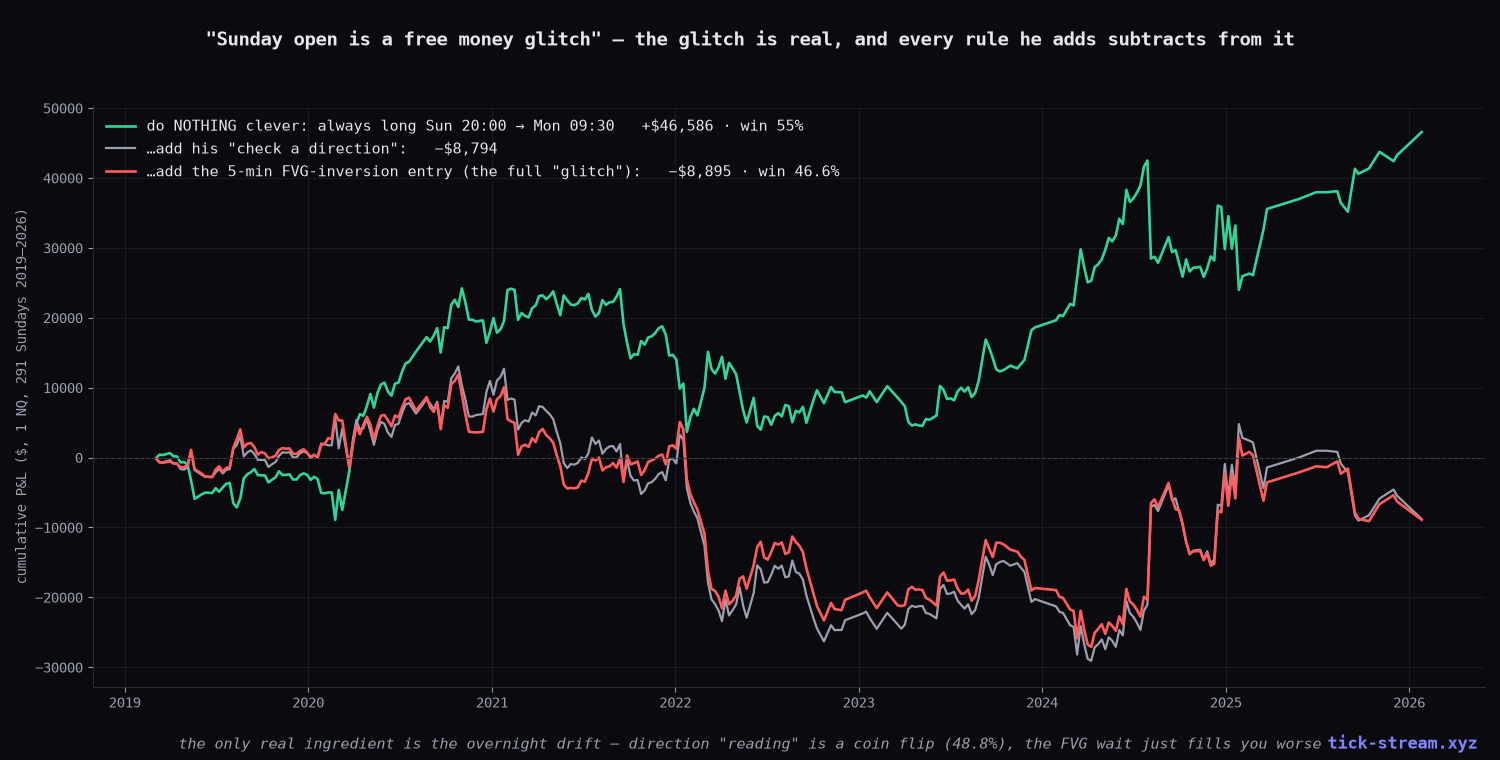
+$46,586. 55% win rate. About +8.7 NQ points per Sunday night.
That is the overnight drift — the extensively documented tendency of equity index futures to accrue their gains outside regular hours. In our session audit it measured +10,800 NQ points over seven years, most of it in the Asia window. It is real, it is free in the sense of requiring no signal at all, and it is almost certainly what the guru’s Sunday anecdotes are made of.
Now watch what his rules do to it. Add the direction check: −$8,794 — because a coin-flip filter puts you short against the drift half of all Sundays. Add the FVG-inversion wait on top: −$8,895 — you enter later, at worse prices, with the same coin-flip direction. Every layer of apparent sophistication converts a genuinely free +$46k ingredient into a losing strategy. The distance between “do nothing” and “do what he says” is fifty-five thousand dollars.
The pattern, filed
This is a shape we keep meeting: a real, well-known background effect (drift), wrapped in rules that feel like skill, sold on anecdotes that the rules themselves would have prevented (“we were watching a movie”). The tell is always the same — the claim never quantifies the control. Ask what doing nothing would have made, and most free-money glitches resolve into free-money drift plus expensive decoration.
(And no — before you ask: we don’t trade the drift as a standalone product either. t = 1.24 over 291 Sundays is a real phenomenon but not a deployable edge on its own; it’s already inside our daily sleeves, which hold overnight by design.)
Methodology: NQ, 291 Sunday sessions 2019-03 → 2026-02, 1-minute bars built from real trade prints (quote-rule aggressor, documented provenance), aggregated to 5-minute for FVG logic. Sessions in ET, DST-safe. FVG: three-candle imbalance; inversion = 5m close through the zone. Entries at trigger close ±1 tick; exits as tabled, 2-tick adverse slip on stops/time exits; $14.50 RT. Session coverage per our house rule: this is an Asia-session claim tested on full 23h Globex data with overnight cost stress (+1/+2 ticks). Controls: always-long, direction-only, Mon–Thu placebo evenings. Scripts and per-Sunday P&L archived.
Frequently asked questions
Does the 'Sunday open free money glitch' strategy work?
No. On 291 Sundays of real NQ tick data (2019–2026), the full mechanic — read the direction at 8 p.m., enter on the first 5-minute fair-value-gap inversion in that direction — lost money in every exit variant we tested: −$8,895 holding to Monday's open, −$17,745 exiting at the Asia close, −$6,395 with a 2R bracket. 'Fails never' is, measured, a 46.6% win rate — and 16.6% in the bracket variant.
Does the Sunday-evening direction predict where price goes next?
It's a coin flip. The direction of the move from the 18:00 ET Globex open to 20:00 ET agreed with the subsequent move to Monday's 09:30 open 48.8% of the time — slightly worse than random — with a t-statistic of −0.12. To Monday's close: 50.9%, t = −0.36. The same read on Monday–Thursday evenings: 49.5%. 'Check a direction' contains no information on any evening of the week.
Is there anything real behind the Sunday-open pattern?
Yes — and that's the interesting part. Simply being long from Sunday 20:00 ET to Monday's 09:30 open, with no direction check and no entry pattern at all, made +$46,586 over the same 291 Sundays (55% win rate, ~+8.7 NQ points per night). That is the well-documented overnight drift — NQ accrues most of its gains outside regular hours. The guru's rules subtract from it: the direction filter puts you short against the drift half the time, and waiting for an FVG inversion fills you later at worse prices. His edge is drift, repackaged — minus $55k of rule damage.
What is an inversion fair value gap (IFVG)?
A fair value gap is a three-candle imbalance (candle 1's high below candle 3's low, or mirrored). An 'inversion' FVG is one that fails: price closes back through the gap, and the zone is said to flip roles from resistance to support (or vice versa). We implemented exactly that on 5-minute bars as the entry trigger — bearish FVG inverted by a close above it = long entry. As a Sunday-evening entry signal it only degraded results versus entering with no pattern at all.
Was this tested outside the New York session?
This claim IS an overnight-session claim, and it's the first test to run under our new house rule: every intraday backtest covers Asia, London and NY session contexts, on full 23-hour Globex bars built from real trade prints, with overnight cost stress (+1 and +2 ticks) — because overnight spreads are 2–3× wider than RTH. The strategy failed before the cost stress; the stress only deepened it.