Regime Score: A Breakout or Mean-Reversion Call, Frozen Before the Open and Graded in Public
Every morning the regime score reads the dealer gamma board and calls the NQ session breakout or mean reversion, with a conviction from 0 to 10. On seven years of reconstructed boards it sorts the day's range well, and better out of sample than in the fitted years. It does not sort trend days from reversal days, and its first six live weeks graded below a coin flip. Both halves of that are on this page.
The regime score panel answers one question each morning: will today’s NQ session be wide or narrow? It reads the dealer gamma board, calls the day breakout or mean reversion with a conviction from 0 to 10, freezes that call before the session has had a chance to show its hand, and grades it against the session after the close. The panel keeps the recent calls underneath, hits and misses alike.
The word breakout promises more than the score measures, so this page is careful about what the call means. Breakout means expansion: a wide range. It does not mean a trend day, and it does not mean a direction.
How the terminal computes it
- The board. At 09:35 ET the terminal takes the net dealer gamma of the whole QQQ option chain (it scores NQ only, because that is the pair it is calibrated on) and places it as a percentile of the last 250 morning boards. Low percentile means dealers are shorter gamma than on most mornings of the past year, high means longer.
- The call. A logistic model fitted on 2019 to 2023 only turns that percentile, and the sign of net gamma, into a probability of an expansion day. Above 0.55 the call is breakout, below 0.45 mean reversion. In between the score abstains with neutral, which it did on 18% of days in the record.
- Conviction. The distance of that probability from a coin flip, scaled so that 10 is the most confident reading the model actually produces.
- The freeze. The call is written once, between 09:35 and 11:40 ET, and never touched again. If the feed is stale or the window has passed, there is no call for that day, not a late one.
- The grade. After the close the session’s regular-hours range (09:30 to 16:00 ET) is placed as a percentile of the trailing 250 sessions. A breakout call scores that percentile, a mean-reversion call scores 100 minus it. 50% is a coin flip. A session with missing bars stays ungraded.
The record the panel shows has two parts: 1,746 days rebuilt from our option-chain archive (May 2019 to 12 August 2026, each from the board as it stood that morning, marked as backfill) and every live call since 13 August 2026.
What our data says: it sorts the range, in and out of sample
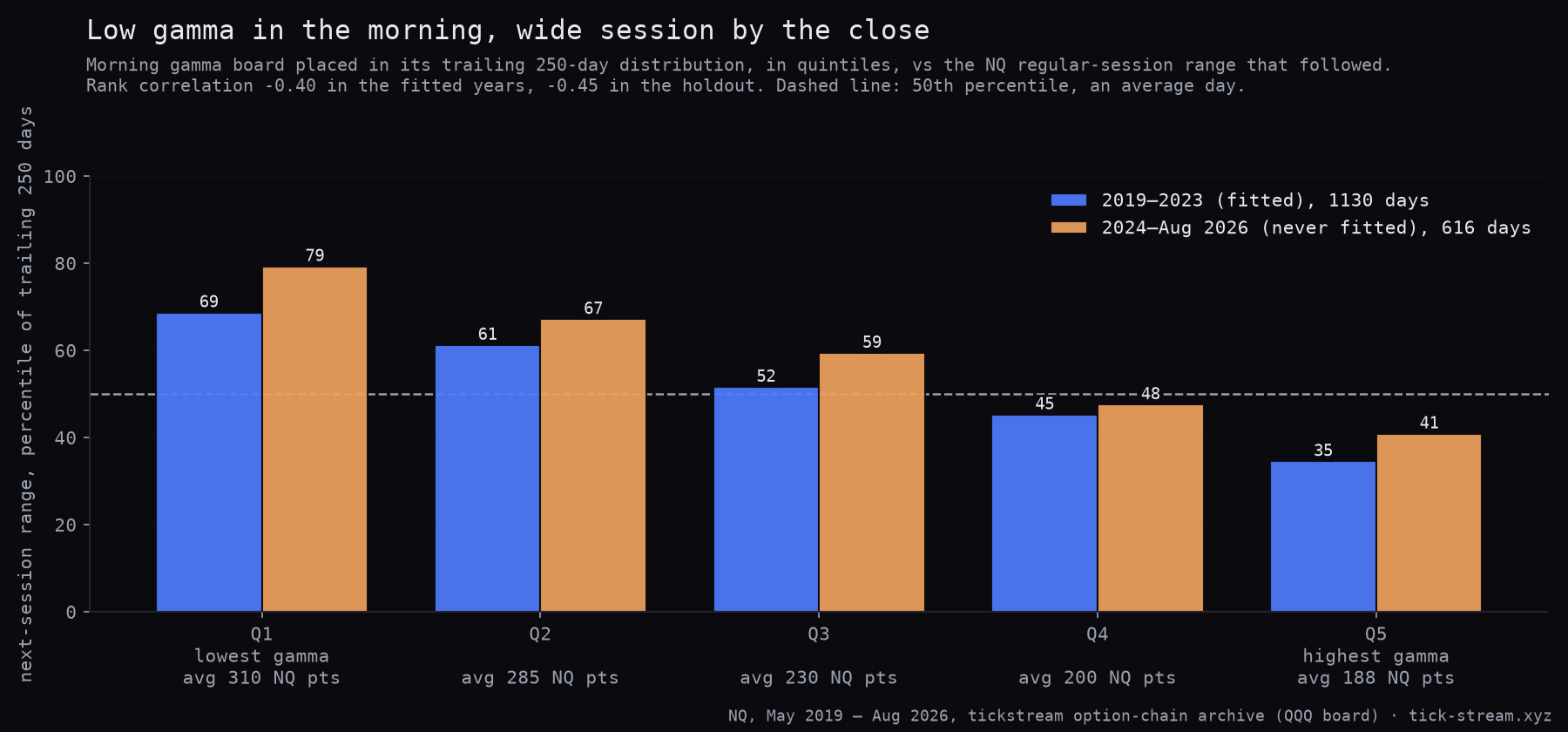
Split the archive days into fifths by the morning gamma percentile and the range that followed falls away in steps. The lowest-gamma fifth averaged the 69th range percentile in the fitted years and the 79th in the holdout. The highest-gamma fifth averaged the 35th and 41st. In NQ points that is 310 against 188 points of regular-hours range.
| 2019–2023 (fitted) | 2024–Aug 2026 (holdout) | |
|---|---|---|
| Days | 1,130 | 616 |
| Rank correlation, gamma percentile vs range percentile | −0.40 | −0.45 |
| Graded calls (neutral days excluded) | 909 | 519 |
| Average grade | 62.7% | 64.0% |
| Calls better than a coin flip | 67.0% | 69.9% |
| Average grade, conviction 0–4 / 5–7 / 8–10 | 56 / 62 / 69% | 57 / 63 / 73% |
The holdout is what makes this worth a panel. Those two and a half years were never used to fit anything, and the separation there is slightly stronger than in the years the model saw. Conviction behaves as it should: low-conviction calls barely beat a coin flip, high-conviction calls grade around 70%.
One asymmetry. In the holdout, breakout calls graded 70% on average and mean-reversion calls 56%. A short-gamma board is a reliable sign of a wide day. A long-gamma board is a weaker sign of a quiet one: plenty of wide sessions still start from a long-gamma morning.
What it does not tell you: trend or reversal
The first version of this score tried to call something else: whether the day would trend (close near one end of its range) or revert (close back in the middle). We measured that as |close − open| / range, placed in the same trailing distribution, over 1,698 sessions. The rank correlation with the gamma percentile was −0.07. The trendiness percentile went from 54 in the lowest-gamma fifth to 47 in the highest, which is too little to call. We dropped that target and kept range.
So a breakout call says the tape is likely to travel. It does not say the travel will be one-way, and it says nothing about direction. That is the same line as the volatility regime panel: gamma carries magnitude, not direction.
The live record: 26 calls, below a coin flip
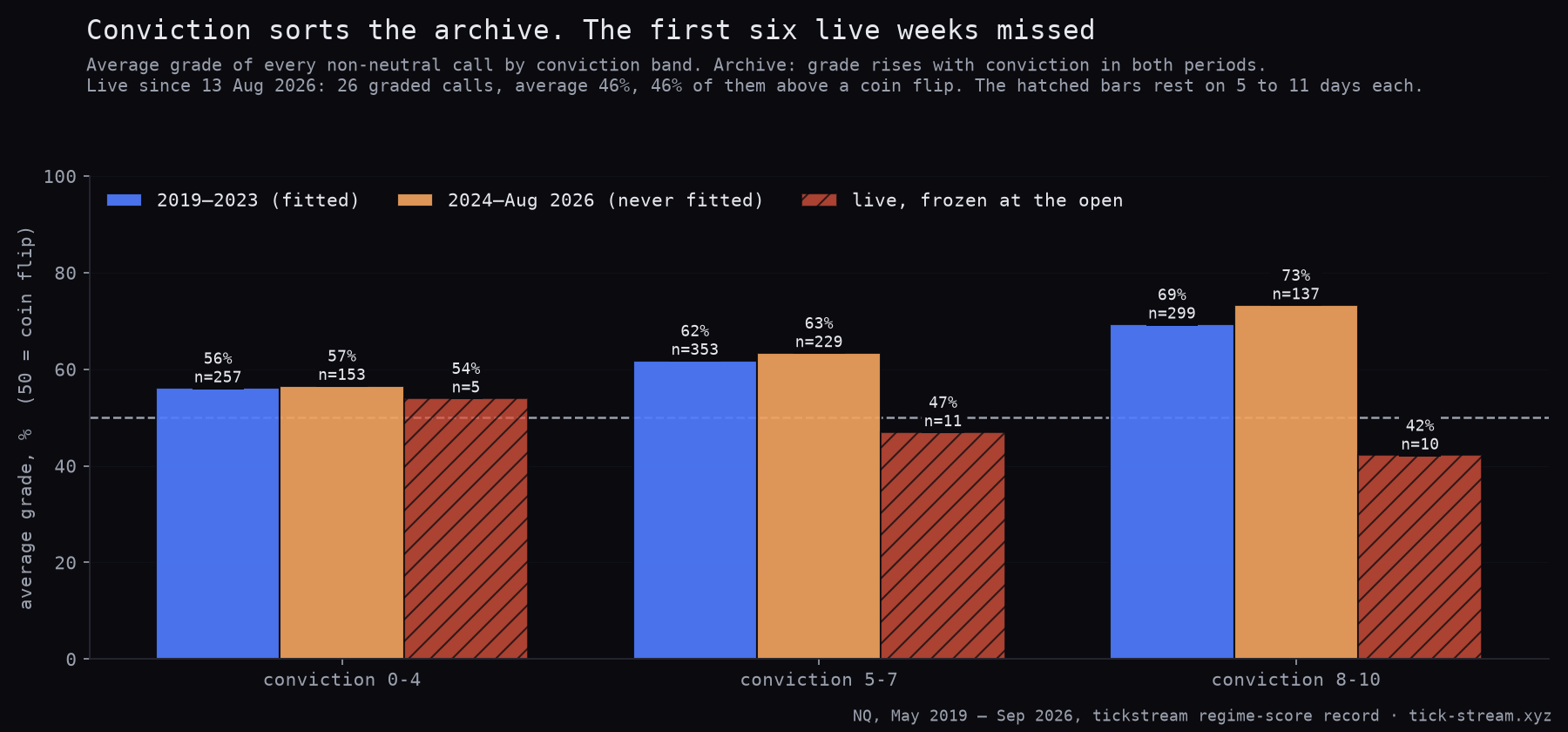
The live record started on 13 August 2026. To 25 September the score froze 32 calls: 26 graded, 5 neutral, and one on a holiday session without enough bars to grade. The 26 graded calls average 46.5%, and 12 of them (46%) beat a coin flip. The conviction 8–10 calls did worst, averaging 42% over 10 calls.
We are not going to explain that away. Two things put it in proportion:
- It is 26 calls. In the archive, about 4% of all 26-call stretches graded as low as this one or lower. Unusual, but a run like this has happened before inside a record that averages 63%.
- The relationship itself has not shown up yet. Over these six weeks, sessions after a long-gamma board had wider ranges (328 points on 13 days) than sessions after a short-gamma board (275 points on 18 days), the reverse of the archive. Several of the misses were high-conviction mean-reversion calls on days with a large move, including a 646-point session on 21 September.
The honest reading is that it is too early to say whether the live record will converge on the archive. The panel will show it either way.
How to read it in the terminal
- Treat it as a sizing input. A breakout call with high conviction argues for wider stops and more distant targets, a mean-reversion call for tighter ones. The same stop is a different bet in a 190-point session and a 310-point one.
- Pick the trade type to it. Fading extremes fits compression days. Following a break fits expansion days, and fading one on a short-gamma morning is how you get run over.
- Read the conviction, not just the word. Conviction 0–4 is only a little better than no call in the archive. A neutral day is the score saying it has nothing, and it is fine to believe it.
- Look at the record, not the call. A single call is one draw. The recent calls in the panel and the long-run numbers above are what the score is actually worth.
Limits worth knowing
- Calibrated on QQQ for NQ. The score runs for NQ only. ES and other symbols get no call, because the model was fitted on a QQQ board against NQ sessions.
- One number per morning. The call is frozen at the open and does not react to anything that happens after it. A regime that changes at 11:00 on news is not in it.
- The archive is rebuilt. The 1,746 backfill days use end-of-day chains and open interest, projected to the next morning. Live boards read the chain at 09:35. Close, but not the same measurement, and one candidate reason the live record could differ.
- Early live record. Six weeks of live calls graded below a coin flip. That may be a bad stretch or a sign that something has changed; there are not enough days yet to tell which.
The full research write-up, including the trendiness target we rejected, is in the regime score article. The same score runs free under the chart on the real-time GEX levels page.
Methodology: tickstream regime-score record, NQ, 1,746 backfilled sessions (27 May 2019 to 12 August 2026) rebuilt from QQQ end-of-day option chains and open interest in our archive, plus 32 live calls frozen between 13 August and 25 September 2026. Score = logistic model on the morning net-gamma percentile (trailing 250 boards) and the sign of net gamma, fitted on 2019–2023; holdout = sessions from January 2024. Grade = percentile of the realised regular-hours range in the trailing 250 sessions (inverted for mean-reversion calls); neutral calls not graded. Rank correlations are Spearman. Trendiness check: |close − open| / range of the next session, as a trailing percentile, over 1,698 sessions. Live-stretch comparison: share of all consecutive 26-call windows in the backfill with an average grade of 46.5% or lower.
Frequently asked questions
Can gamma exposure predict a breakout day?
It predicts a wide day, which is part of what people mean by a breakout day. On 1,746 NQ sessions from 2019 to 2026, the lowest fifth of morning gamma boards preceded sessions averaging 310 points of regular-hours range and the highest fifth 188. Out of sample, from 2024 on, the separation was slightly stronger than in the years the model was fitted on. Whether the wide day trends one way or swings both ways is a different question, and gamma answers it hardly at all.
What does breakout mean in the regime score?
Expansion. A breakout call says the session's range is likely to be wide relative to the last 250 sessions; a mean-reversion call says it is likely to stay compressed. Neither call says which way price will go, and a breakout call is not a prediction that price will leave a particular level.
How is the regime score graded?
After the close the realised regular-hours range of NQ is placed as a percentile of the trailing 250 sessions. A breakout call's grade is that percentile, a mean-reversion call's grade is 100 minus it, so 50% is exactly a coin flip. Neutral days are not graded, and a session without a near-complete set of bars stays ungraded rather than being guessed.
How accurate is the regime score?
In the archive, where every call was rebuilt from the board as it stood that morning, the average grade was 63% in the fitted years 2019 to 2023 and 64% in the 2024 to 2026 holdout, with conviction 8 to 10 calls averaging 69% and 73%. The live record started on 13 August 2026 and after 26 graded calls averages 46%. That stretch is short, and the archive had comparable ones: about 4% of all 26-call runs graded this low.
Can I trade the regime score on its own?
No. It has no direction, so there is nothing to buy or sell from it alone. Use it to set stop width, target distance and whether to fade or follow the moves your own process gives you.